
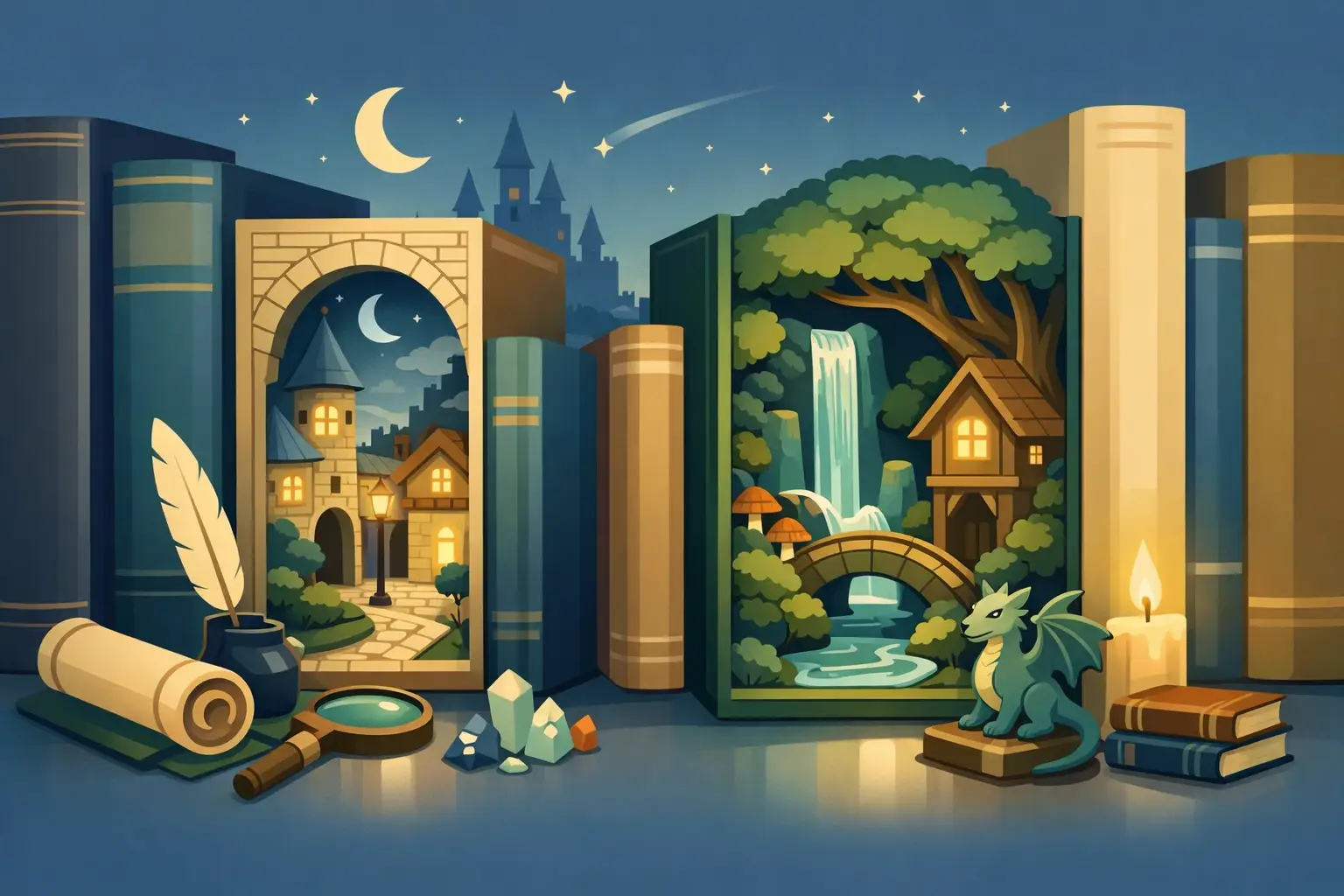
A good shelf tells stories before anyone opens a book. Fantasy book nook kits take that notion and give it tiny lanterns, crooked doorways, mossy stones and the suspicious feeling that a dragon may be charging rent behind your paperbacks. Tucked between books, they turn a perfectly ordinary bookcase into a secret alley, wizard’s study or woodland path.
They are brilliant for fantasy readers, tabletop players, miniature collectors and anyone whose home decor has been accused of being “a bit much”. Correct. A bit much is where the magic lives. The trick is choosing a nook that suits your shelf, your patience and the sort of fictional world you would most like to accidentally fall into.
What makes fantasy book nook kits so addictive?
A book nook is a narrow miniature scene designed to sit between books. Most kits arrive as laser-cut wooden pieces, printed details, wiring, LEDs and enough small components to make your fingertips briefly question your life choices. Once built, the scene creates an illusion of depth: a doorway that seems to lead forever, a tavern lane at dusk, a library staircase disappearing into shadow.
Fantasy is particularly suited to the format because it thrives on thresholds. A glowing archway, an old map, a spell book left open on a desk – each tiny detail suggests a much larger world beyond the shelf. You are not just displaying an object. You are giving your favourite novels an escape route.
There is also a lovely practical reason these kits have taken off. Unlike a large figure or display cabinet, a book nook uses the forgotten gap between books. It adds personality without demanding another shelf, another side table or a delicate explanation to a flatmate who thinks their beige candle collection counts as decor.
Choose a fantasy book nook kit by mood, not hype
The best design is rarely the one with the most pieces. It is the one that makes sense beside the books, dice, plants or gothic clutter you already own. Start with the mood you want your shelf to have.
The enchanted forest nook
Forest scenes bring twisting roots, hidden cottages, glowing mushrooms and plenty of green. They work beautifully beside folklore, cosy fantasy and nature-inspired witchy decor. Choose one with warm lights if you want a welcoming woodland feel; cooler white or blue lighting creates something more moonlit and fae, which is charming until the fae asks for your name.
These kits can be especially satisfying to personalise. A little extra moss, a painted mushroom cap or a miniature raven changes the finished scene without requiring expert modelling skills.
The wizard’s library or study
If your bookshelves are already carrying fantasy novels, spellbooks, RPG manuals or occult titles, a miniature library is the obvious little menace. Look for ladders, shelves, globes, potion bottles and amber lighting. A study nook sits comfortably among darker decor because it feels like a room that has been lived in by someone clever, secretive and not entirely trustworthy.
This style is usually detail-heavy. That makes it a rewarding long build, but perhaps not the first choice if you want to finish it in one relaxed Sunday afternoon. Tiny books are adorable. Tiny books also require precision, apparently.
The medieval street or tavern alley
Cobblestones, shop signs, wooden beams and warm windows suit readers who want a little storybook town on the shelf. This is a strong choice for Dungeons & Dragons players because it can resemble the sort of alley where a party receives a dubious quest from a hooded stranger.
Street scenes tend to look their best when viewed straight on, so check that the shelf is at a comfortable height. Put one too low and you will mostly admire the roof. Put it too high and the details vanish into the ceiling’s mysterious realm.
The dark castle or gothic corridor
For the household with black bookcases, skull ornaments and a refusal to apologise for velvet, choose stone arches, candlelit halls and shadowy windows. Gothic fantasy nooks look excellent against dark spines and can make a compact collection feel wonderfully theatrical.
The trade-off is visibility. Very dark scenes need well-placed LEDs or their most interesting details disappear. Battery lighting may be enough for a small display, while USB-powered lighting is often better if the nook will stay illuminated for long evenings of reading, gaming or dramatically staring into the middle distance.
Check the practical bits before adopting a tiny kingdom
A book nook should fit your shelf, not become a very pretty item you keep in its box while saying you will “make space soon”. Measure the gap between your books, the shelf depth and the available height. Most nooks are designed to be slim, but depth varies, particularly for scenes with deep perspective or protruding trees.
Then consider the build itself. A kit with numbered wooden sheets and clear instructions is far friendlier for beginners than one that expects you to identify twenty nearly identical tabs by instinct alone. If painting is included, decide whether you genuinely fancy a craft project or would rather have pre-coloured pieces. There is no moral virtue in making your own life fiddlier.
Lighting deserves a proper look too. Battery packs are flexible, especially where there is no socket nearby, but batteries need replacing and a visible switch can be awkward to hide. USB lights are convenient for a permanent display, provided the cable can reach discreetly. Check whether batteries, glue and paint are included. Many kits require PVA or wood glue, and some use tiny electronic connections that reward patience and good lighting.
Building without turning the quest into a boss fight
Make the build pleasant from the start. Clear a table, use a tray or shallow box for loose pieces, and keep the instructions somewhere they will not be glued to the furniture. Dry-fit unfamiliar pieces before applying adhesive. That one small pause saves an astonishing amount of swearing later.
Work in stages rather than trying to complete every element at once. Build the structure first, then add interior details, then test the lights before sealing anything behind a wall. If a wire slips or an LED fails, you will be grateful not to have created a beautifully decorated miniature prison around it.
Paint and weathering are optional, but they add character. A thin wash of darker paint can settle into carved stone or wood grain, making flat pieces look older and more convincing. Metallic wax or a dry brush of pale paint can make a tiny sign, sword or window frame catch the light. Keep it restrained. A touch of grime says ancient tavern; too much says the goblins have not cleaned since 1432.
If you are making one as a gift, allow more time than you think. A kit can be a fantastic present for a crafty fantasy fan, but it is not always a “build it before tea” situation. Giving the kit unbuilt is completely valid. Giving it built and lit is heroic. Giving it built but slightly wonky is proof it was made by human hands, which is more charming than factory perfection anyway.
Styling a finished fantasy book nook
A nook looks most convincing when it has book neighbours that support the illusion. Place a forest scene between fairy tales, cottagecore fantasy or botanical titles. Put a wizard’s study among epic fantasy and tabletop rulebooks. A gothic corridor beside vampire fiction, dark academia or horror creates a shelf with a properly coherent atmosphere.
Avoid cramming every collectible around it. The nook needs a clear viewing angle and a little breathing room for its depth effect to work. One or two companions – a dragon figure, a set of favourite dice, a candle holder safely kept well away from paper and wiring – are plenty.
Think about ambient light, too. Daylight shows paint and texture; low evening light makes LEDs do the dramatic work. If the nook has a mirror at the back, position it where it will not reflect a bare wall or the chaos of your laundry pile. Miniature magic has limits.
Is a kit always the right choice?
Not necessarily. Kits are satisfying because the finished piece carries your effort, and they suit people who enjoy constructing, painting and fussing over details. But they take time, require a modest amount of dexterity and can be frustrating if the instructions are poor.
A ready-made or 3D-printed book nook may be the better route if you want instant shelf theatre, have limited crafting space or are buying for someone who loves fantasy but does not love glue. Pre-built pieces can also be sturdier and easier to personalise with small accessories. On the other hand, they may offer less of that slow, meditative making experience that turns a kit into a weekend ritual.
Choose the version that will actually bring you joy, not the version that sounds most impressive. Your shelf does not award achievement badges. Yet.
A fantasy book nook earns its place when it feels like your own private portal: a little light among the spines, a tiny world waiting after a long day. Pick the scene that makes you pause every time you pass it, then give it a good home between the books. Planet Goblin approves of any shelf that looks faintly haunted, gloriously nerdy and difficult to dust.