
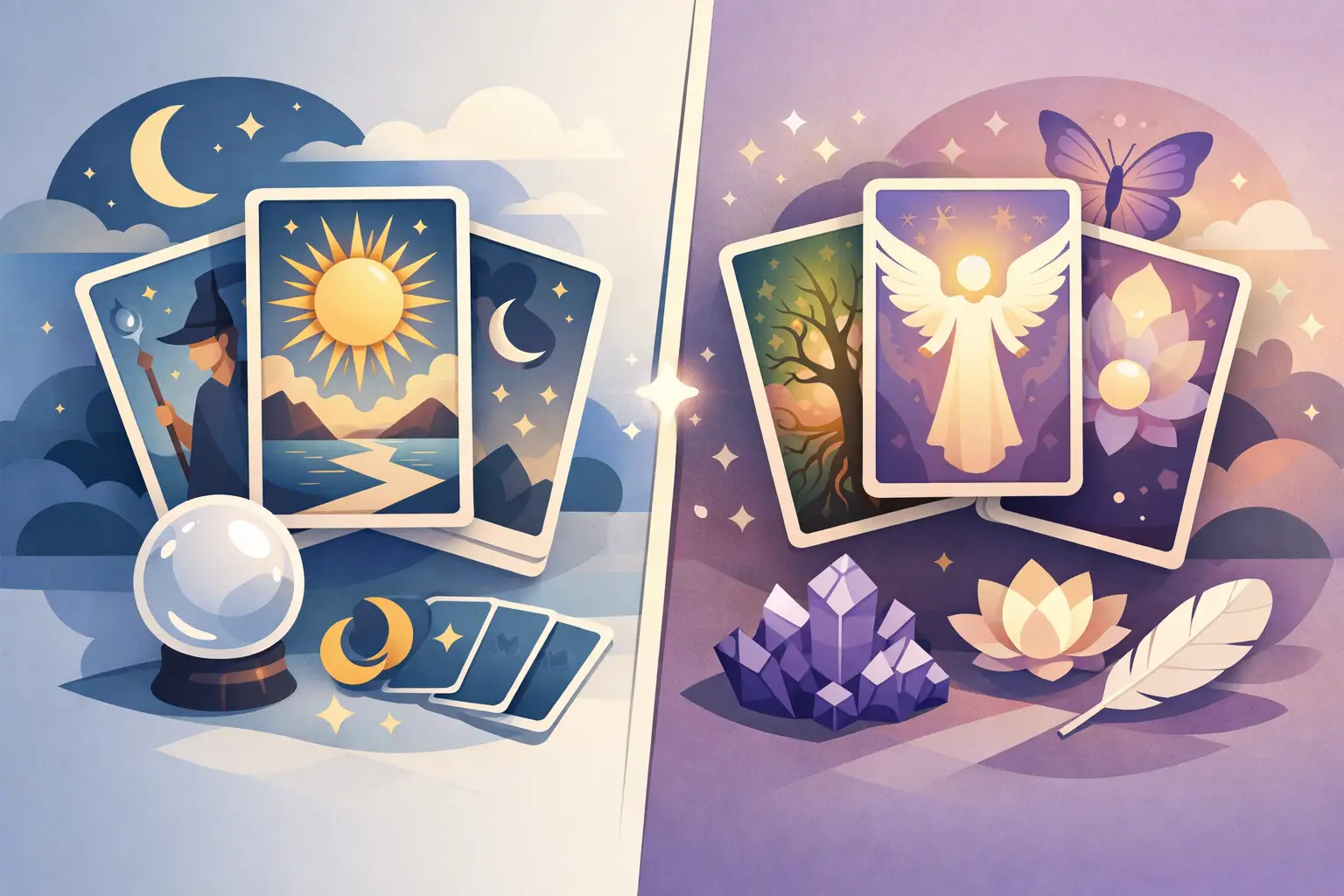
A gorgeous deck can make a witchy little goblin brain immediately yell, “Mine.” But with tarot cards vs oracle cards, the artwork is only half the story. One deck may offer a carefully mapped symbolic system; another may give you a direct, intuitive nudge when your thoughts are behaving like a bag of feral dice. Neither is the more magical choice. They simply invite you to read in different ways.
Tarot cards vs oracle cards: the real difference
Tarot follows a recognised structure. Most traditional tarot decks contain 78 cards: 22 Major Arcana cards and 56 Minor Arcana cards. The Major Arcana includes big archetypal figures and turning points such as The Fool, Death, The Moon and The World. No, Death does not usually mean someone is about to dramatically expire. It more often points to endings, change and the inconvenient but necessary act of shedding an old skin.
The Minor Arcana is split into four suits, commonly Wands, Cups, Swords and Pentacles. These explore the ordinary mortal business of ideas, emotions, conflict, work, money, home and relationships. Each suit generally runs from Ace to Ten, followed by court cards such as Page, Knight, Queen and King.
That familiar framework is why tarot can feel like learning a new language. A card’s meaning is shaped by its number, suit, imagery, position in a spread and the question being asked. Once you start recognising patterns, readings gain extra layers. Three Swords cards in a reading may tell a rather pointed tale. A spread full of Pentacles may have you examining practical matters rather than waiting for a moonbeam to pay the council tax.
Oracle decks have no universal rulebook. An oracle deck may have 36 cards, 44 cards, 60 cards or any number its creator fancies. Its theme could be lunar phases, plants, dragons, shadow work, folklore, affirmations, ancestors, gothic aesthetics or cryptids with suspiciously good advice. The cards often have clear titles or guidebook messages, and the deck’s creator decides how it works.
That freedom makes oracle cards beautifully approachable, but it also means one oracle deck can feel completely unlike another. A tarot reader can usually pick up an unfamiliar Rider-Waite-Smith-inspired deck and recognise the system. With an oracle deck, you are stepping into that particular artist’s strange and wonderful corner of the woods.
Why tarot rewards patience
Tarot is excellent for readers who enjoy symbolism, story and a little study. You do not need to memorise all 78 cards before pulling your first spread, despite what the gatekeepers may mutter from their crumbling towers. Start with the images. What is happening in the scene? Which details tug at your attention? What feeling arrives before you reach for the guidebook?
Over time, learning traditional associations gives you more tools to work with. The Five of Cups may suggest grief, disappointment or noticing what remains after a loss. The Ace of Wands may speak of inspiration, desire or a spark that needs feeding. Those meanings are not a set of handcuffs. They are a shared symbolic vocabulary, useful when you want depth rather than a single, pre-packaged answer.
Tarot also lends itself well to structured spreads. A three-card reading can explore situation, obstacle and advice. A larger spread can examine different influences around a decision. Because the system has suits, numbers and recurring archetypes, it can reveal themes across the whole layout, not just card-by-card messages.
The trade-off is that tarot can initially feel intimidating. There are more cards, more traditional meanings and more visual details to notice. If your idea of a relaxing evening does not involve remembering whether the Knight of Swords is charging towards truth or being spectacularly impulsive, that is fair. The cards will still be there when you fancy a go.
Reversals are optional, not a wizarding exam
Many tarot readers use reversed cards to add another shade of meaning: blocked energy, an internal experience, excess or a different angle on the upright card. Others read every card upright and get insightful readings just fine. There is no tarot police force waiting behind a velvet curtain. Try reversals if they intrigue you; skip them if they make your spread feel like homework.
Why oracle cards are gloriously flexible
Oracle decks tend to offer a more immediate conversation. You might pull a card labelled “Rest”, “Boundaries”, “Transformation” or “Trust Your Path”, then use its art and guidebook entry as a prompt for reflection. That makes them particularly friendly for daily draws, journalling, meditation and moments when you want a little perspective without consulting a symbolic encyclopaedia.
Their themes can be part of the joy. A botanical oracle may suit someone who feels at home with herbs and seasonal rituals. A dragon-themed deck makes a fine companion for fantasy lovers who would absolutely accept advice from a winged beast sitting atop a treasure hoard. Darker decks can support shadow work or gothic self-reflection, while gentler decks may offer comforting encouragement.
Freedom has a flip side, of course. Because there is no shared oracle structure, the quality of guidebooks and card messages varies enormously. Some decks offer thoughtful, nuanced prompts. Others can feel vague, repetitive or relentlessly cheery at exactly the moment you need an honest word rather than a glittery command to “vibrate higher”. Read a few sample cards when possible and trust your reaction to the art and language.
Oracle cards are not automatically simpler than tarot. A richly layered mythology-based oracle can ask plenty of you, while a tarot deck with clear imagery can be wonderfully beginner-friendly. The better question is whether a deck’s way of speaking makes you want to return to it.
Choosing between tarot and oracle cards
Choose tarot if you want a system you can grow into. It is a strong fit for people who enjoy learning lore, spotting connections and building readings that become more detailed over time. It can be especially satisfying if you like the same itch scratched by tabletop games: a clear framework, endless interpretations and enough hidden depth to keep you occupied for years.
Choose oracle if you want a deck that feels personal from the first shuffle. It is ideal for quick check-ins, creative prompts and themed practices. If you are buying a gift for someone whose taste is delightfully specific, an oracle deck built around their favourite aesthetic can feel more intimate than a traditional deck. A woodland witch, a moon devotee and a horror-loving goth may all want guidance, but they do not necessarily want it delivered by the same set of illustrated cups.
If you are new to card reading, do not force yourself to buy the deck you think you are supposed to own. A deck that you find visually irresistible is more likely to leave its box. Look for artwork you can read emotionally, a guidebook you will actually open and card stock that feels pleasant in your hands. Tiny text, overly glossy cards and imagery that leaves you cold are not fatal flaws, but they can turn a lovely practice into a faff.
At Planet Goblin, we are firmly in favour of choosing the deck that makes you want to clear a space, light a candle and ask a slightly ominous question. Questionable manners are optional. Curiosity is not.
Can you use tarot and oracle cards together?
Absolutely. Many readers use tarot for the main story and oracle cards for a final theme, practical suggestion or emotional undercurrent. For example, a tarot spread may show that you are caught between a promising new start and fear of change. An oracle pull can then offer a focused prompt about courage, rest or setting boundaries while you work out what comes next.
Keep the roles clear at first. Draw tarot cards for the question, then pull one oracle card asking, “What would be helpful to remember?” This stops the reading becoming a cardboard avalanche of conflicting messages. As your confidence grows, you can experiment with more elaborate combinations, seasonal readings or deck pairings based on shared imagery.
Read cards with curiosity, not dread
Whether you choose tarot or oracle, card reading works best as a reflective practice rather than a machine that issues unchangeable verdicts. Cards can help you name a pattern, examine a fear, imagine a possibility or notice the advice you have been expertly avoiding. They cannot replace professional support for health, legal, financial or mental health concerns, and they should not be used to make choices for someone else without their consent.
Ask open questions that leave room for your own agency. “What should I understand about this situation?” often gives a richer reading than “Will this definitely happen?” Keep a notebook if you enjoy seeing how meanings shift over time. Some readings land at once; others make sense three weeks later while you are making tea and realise the cards were being annoyingly perceptive.
Pick the deck that makes you feel curious enough to shuffle again. A tarot deck can become a lifelong symbolic companion; an oracle deck can offer a beautifully direct voice when life gets noisy. There is room on the shelf for both, and frankly, a well-stocked shelf is rarely a bad thing.