
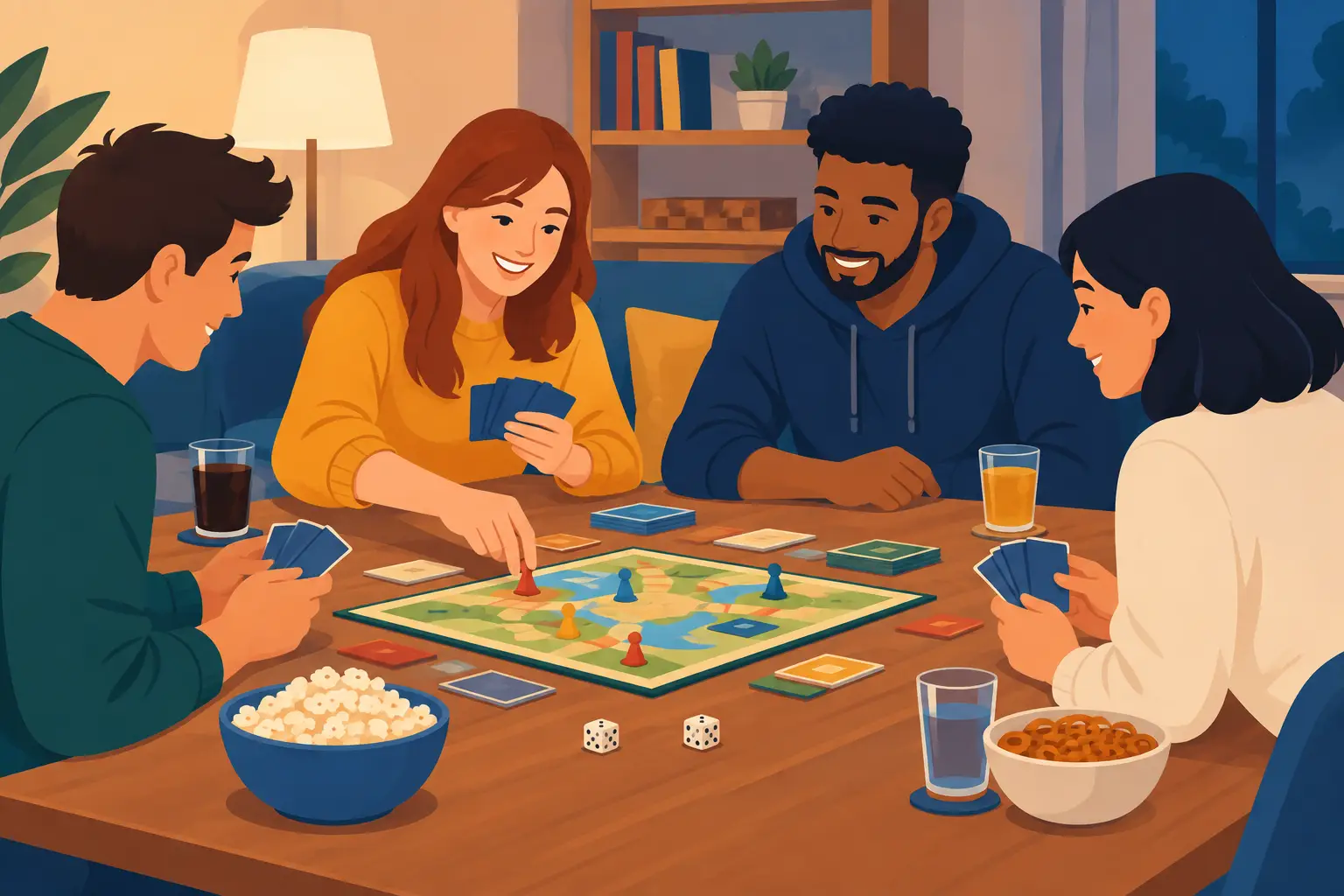
A good tabletop game night is not measured by who wins. It is measured by the moment someone makes an unnecessarily dramatic betrayal, a die rolls under the sofa, and the whole table agrees that yes, the rules probably allow it. This tabletop game night guide is for building that sort of evening – welcoming enough for first-timers, satisfying enough for veterans, and only mildly vulnerable to snack-related disasters.
Start with the humans, not the rulebook
Before choosing a game, work out who is actually coming. This sounds painfully sensible, which is deeply un-goblinlike, but it prevents the classic mistake of laying out a three-hour strategy epic for six mates who mostly want to chat, eat crisps and accuse one another of treachery.
For a mixed group, aim for games with a short explanation, clear turns and enough interaction to keep spectators interested. Party games, social deduction games, light card battlers and cooperative adventures usually earn their place here. If everyone already knows their way around a character sheet or has a competitive glint in their eye, a longer campaign session or heavier board game can be glorious.
Also consider the balance between familiar and new. A beloved game gets everyone playing quickly, while one new title gives the night a sense of occasion. Introducing three unfamiliar games in one evening, however, is how you become the person saying “it’s easy once you understand the phases” while your guests quietly become furniture.
Match the game to the room
Guest count matters more than people think. A game that sings at four can become a slow, noisy swamp at seven, particularly if every turn requires calculating resources or reading a paragraph aloud. Check player numbers before issuing invitations, then have a compact backup game ready for anyone who arrives late or needs to leave early.
Your space matters too. A coffee table is perfect for a compact card game but miserable for a sprawling fantasy board covered in tokens, maps and tiny plastic goblins. If table space is limited, choose games with small footprints or use side tables for snacks and drinks. Nobody needs a mug of tea hovering over the dungeon map like an incoming weather event.
Set the mood without making it a production
Atmosphere does useful work. It signals that this is not just a Tuesday in the living room but a properly designated gathering of suspiciously competitive creatures. You do not need to transform your flat into a full tavern, although nobody at Planet Goblin would stop you.
Clear enough space for everyone to sit comfortably, make sure the lighting lets players read the cards, and keep music low enough that people can hear rules explanations. A fantasy playlist suits a dungeon crawl. Synthy horror works for a tense deduction game. For a chaotic party game, pick something upbeat and unobtrusive rather than an entire album of medieval battle chants. The lute solo may be artistically exquisite; it is not helping anyone remember whose turn it is.
A themed detail goes a long way. Put candles or battery lights around the table for gothic atmosphere, use a dramatic dice tray for role-playing games, or set out a deck of unusual playing cards for a quick warm-up round. The aim is a little theatre, not logistical exhaustion.
Choose snacks that respect the components
There is a special circle of gaming-table misery reserved for sticky fingers touching cards. Serve food that can be eaten with one hand and will not shed a blizzard of orange dust across the board. Bowls, napkins and somewhere obvious to put drinks are simple host magic.
Crisps are absolutely allowed, obviously. Just decant them into bowls rather than asking guests to reach across a kingdom of painted miniatures with a family-sized packet. Popcorn, pretzels, grapes, mini sausage rolls and bite-sized biscuits generally behave themselves. If you are serving something saucy, greasy or gloriously cheesy, give it a dedicated eating break rather than adding it to the table mid-game.
For drinks, coasters are not fussy. They are the last line of defence between a treasured game box and a wet circle of doom. Keep water available alongside whatever more exciting potions are on offer, especially when rules get complicated or the room is warm.
Build your tabletop game night guide around pacing
The best hosts protect the pace. That does not mean policing every conversation like an officious dungeon master. It means knowing when to begin, when to pause and when to call time on a game that has stopped being fun.
Start with something quick. A 15 to 30-minute game gives late arrivals a chance to settle in and lets shy guests find their footing without committing to a full evening of strategic humiliation. Move into the main event once everyone is fed and present, then keep a short, low-stakes option for the end. This is especially useful when half the room is ready for “one more round” and the other half is searching for their coat.
Teach only what players need for their first turn. Explain the goal, the basic flow, the choices available and any rule likely to cause immediate confusion. Leave unusual edge cases until they appear. Most people learn a game better by doing than by listening to a ten-minute lecture delivered over an untouched board.
If one person knows the game, ask them to facilitate rather than dominate. Their job is to keep things moving, remind people of options and answer questions without grabbing the decision from someone else. No one enjoys discovering they have invited a rules oracle who treats every move like a tribunal hearing.
Keep competition friendly, even when it gets feral
Different groups have different appetites for rivalry. Some want optimisation, cunning and a victory lap. Others want a chance to laugh at their own terrible decisions. Neither is wrong, but mixing these expectations without warning can turn a light evening sour.
Set the tone early. Say whether take-backs are allowed, whether alliances are encouraged, and whether the person who has played before will offer tips. In a casual group, a little generosity keeps the table alive. In a fiercely competitive group, clear rules stop arguments from becoming a second game nobody chose.
Cooperative games are a good cure for mixed confidence levels, but watch for quarterbacking. That is when the loudest player starts directing every choice, leaving everyone else as decorative party members. Ask each person what they want to do before discussing the group plan. Heroes deserve agency, even if their plan is objectively to open the cursed door.
Give the table a little personality
Accessories are not mandatory, but they can make game night feel personal rather than borrowed. Dice bags and trays protect both your rolls and your furniture. A dice tower adds satisfying ceremony, particularly for players whose throws regularly launch a d20 into another postcode. Card storage, playmats and token dishes make setup less fiddly and help keep favourite games in good condition.
For role-playing nights, small props can pull newcomers into the story. Let players choose a set of dice, hand out simple character markers, or add a strange little dragon to guard the snacks. For board games, a themed table centrepiece or miniature display shelf can make the room feel like it belongs to the game without blocking anyone’s view.
The trick is choosing one or two details that suit your group. Do not buy a mountain of kit before you know whether your friends are devoted campaign adventurers, card-game fiends or people who just enjoy yelling “I accuse you” over fizzy drinks.
Make people want to come back
A thoughtful ending beats an abrupt packing frenzy. Take a quick photo of the winning board state if everyone is happy to be in it, write down scores for an ongoing league, or let the winner choose the opener next time. These tiny rituals create continuity without making attendance feel like homework.
Then ask one useful question: what should we play next time? You will learn whether the group wants more plotting, more silliness, shorter rounds or a full descent into fantasy campaign nonsense. Leave the dice on the table for a moment, savour the accusations, and start planning the next gathering before the goblins scatter.