
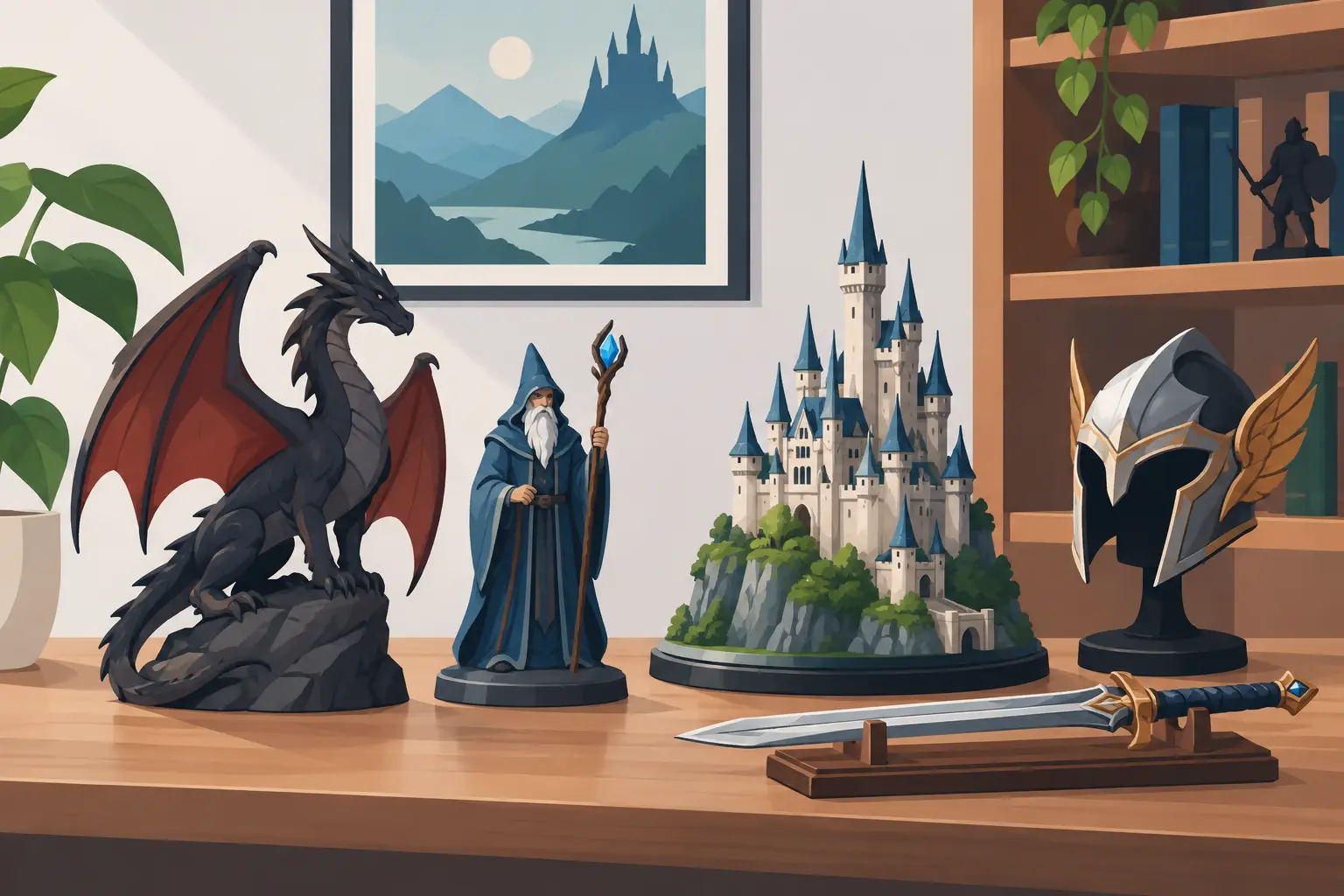
A dragon perched on a bookcase is not just décor. It is a warning to guests that your reading tastes contain at least one cursed sword. The best fantasy collectables do more than fill an empty bit of shelf: they make your space feel recognisably yours, whether that means a dice hoard, a witchy altar corner, a favourite character guarding the desk, or a small army of very judgemental goblins.
Collecting can become expensive faster than a wizard saying “I know a spell for that”, so the trick is not buying everything. It is choosing objects with a story, a purpose, or enough strange little charm that you will still be pleased to own them after the novelty has worn off.
What makes a fantasy collectable worth keeping?
The word “collectable” gets flung around with wild abandon. A branded keyring can be a collectable. So can a limited-run statue, a hand-painted resin familiar, an ornate deck of cards, or a dice tower shaped like a ruined castle. Value is not only about rarity or resale prices. For most collectors, it is about connection.
A brilliant piece usually earns its place in one of three ways. It represents a world you already love, it adds something to a ritual or hobby you genuinely practise, or it looks so good that it gives a room its own tiny dose of magic. The ideal item often does more than one.
Officially licensed merchandise has a particular pull when you care about the details. A Doctor Who accessory, a character-specific Loungefly bag, or a piece of band merch can feel like a proper fragment of the thing you adore, rather than a vague approximation with a suspiciously familiar logo. On the other hand, independently designed and 3D-printed pieces can bring personality that mass-market items simply cannot. Your shelf is allowed to contain both. We are not starting a civil war over dragons.
Start with a collecting lane, not a shopping frenzy
You do not need to pick one fandom for life. That would be dreadfully sensible. But choosing a loose lane keeps a collection feeling intentional rather than like the aftermath of a convention bag exploding in the hallway.
Your lane might be gothic creatures, dragons, tabletop accessories, magical cats, dark academia, horror icons, anime figures, celestial witchcraft, or one specific film, game or television series. You can also collect by mood. A collection built around moonlight, ravens, potion bottles and black-and-gold details can sit together beautifully even if every item comes from a different universe.
Think about what you want the collection to do. A display of figures is mainly visual. A dice collection is visual, tactile and useful at the table. Oracle cards, candle holders and altar pieces can become part of a spiritual practice. Bags, jewellery and apparel move your fandom out of the house, where strangers may compliment it or look mildly alarmed. Both are acceptable outcomes.
There is no need to impose strict rules, but a gentle filter helps. Before adding something new, ask whether it fits your theme, whether you can picture where it will live, and whether you would still want it if nobody else saw it online. That last question saves a surprising amount of money.
Build around one hero piece
A collection looks more impressive when it has a focal point. This could be a larger dragon figure, a detailed book nook, a dramatic dice tower, a display shelf, or a beautifully illustrated tarot or oracle deck. Let that piece set the atmosphere, then add smaller companions around it.
This also makes collecting manageable on different budgets. One special item can anchor a shelf, while smaller additions such as enamel pins, mystery dice, mini figures or charms keep the fun going between bigger purchases. Not every treasure must arrive with an invoice that makes you briefly consider eating only toast for a fortnight.
Fantasy collectables should suit your actual space
Collectors are often told to buy first and worry about display later. This advice was clearly written by someone with infinite shelving and no cats. Space matters, especially with fragile figures, boxed editions and anything featuring delicate wings.
Measure the shelf before choosing a large item. Check its depth as well as its width, and remember that a box can be part of the display if the artwork is good enough. Keep direct sunlight away from printed boxes, fabrics and painted pieces, because fading is the least magical form of ageing. If damp is a problem, avoid storing card decks, paper collectibles and boxed items in sheds, garages or chilly lofts.
A small collection can look deliberate with a little height variation. Stack a couple of favourite hardbacks, place a figure or dragon fidget in front, then use a small riser or display shelf for the items behind. Grouping by colour can be effective, but do not force every piece into a matching palette if it makes you hide the things you actually love.
For tabletop players, practical display earns bonus points. A dice tray, dice tower or storage box can look excellent between sessions and prevent a d20 from making a break for freedom under the sofa. A book nook brings life to a shelf without demanding an entire cabinet. Little functional oddities are often the easiest way to start.
Know when rarity matters and when it does not
Limited editions, convention exclusives and numbered releases can be thrilling. They can also produce panic buying, inflated resale prices and the peculiar misery of refreshing a page at 9am. Rarity matters most if completing a set is part of your joy, or if an item has personal significance that cannot easily be replaced.
Otherwise, do not mistake scarce for special. A widely available item that makes you grin every time you walk past it is a better collectable than an expensive “must-have” that stays sealed in a drawer because you are afraid to touch it.
Condition is similarly personal. If you collect in-box figures or want to preserve resale value, keep packaging tidy and store it safely. If you collect to create a display, opening the box may be the correct choice. The tiny plastic window was never the point. Your enjoyment is.
Gifts are easier with a little detective work
Fantasy collectables make excellent gifts because they can feel deeply specific, but specificity is where well-meaning mortals get caught out. Find out whether the recipient collects a particular character, franchise, creature, colour scheme or game. Notice whether they display items in boxes, use their dice, wear their fandom, or prefer useful things over ornaments.
For someone new to the hobby, a modest but characterful piece is usually safer than an enormous centrepiece. A mystery dice set, a small dragon accessory, themed playing cards, a notebook, a pin or a compact piece of licensed merchandise gives them a way in without deciding their whole aesthetic for them. For an established collector, seek the gaps: storage for their current collection, an accessory for their favourite game, or an item tied to the character they mention far too often.
At Planet Goblin, that overlap is rather the point: one person’s gift list may contain a Wiccan-inspired keepsake, a dice tower, an anime accessory and something involving a dragon with questionable manners. Sensible? Perhaps not. Excellent? Obviously.
Let your collection evolve without guilt
Tastes change. The fandom that ruled your bedroom at sixteen may not be the one you want on the mantle now, and that is not a betrayal of your former self. Rotate displays, pass on pieces that no longer spark anything, and make room for the worlds that currently have their claws in you.
The most memorable collections are not the largest ones. They are the ones where every object feels chosen: the battered deck used for late-night readings, the miniature beholder that has seen too many campaigns, the bag that starts conversations in queues, the odd little figure bought simply because it made you laugh. Keep the treasures that make your corner of the world feel a bit more enchanted. Bramble approves, and I will not be taking questions.