
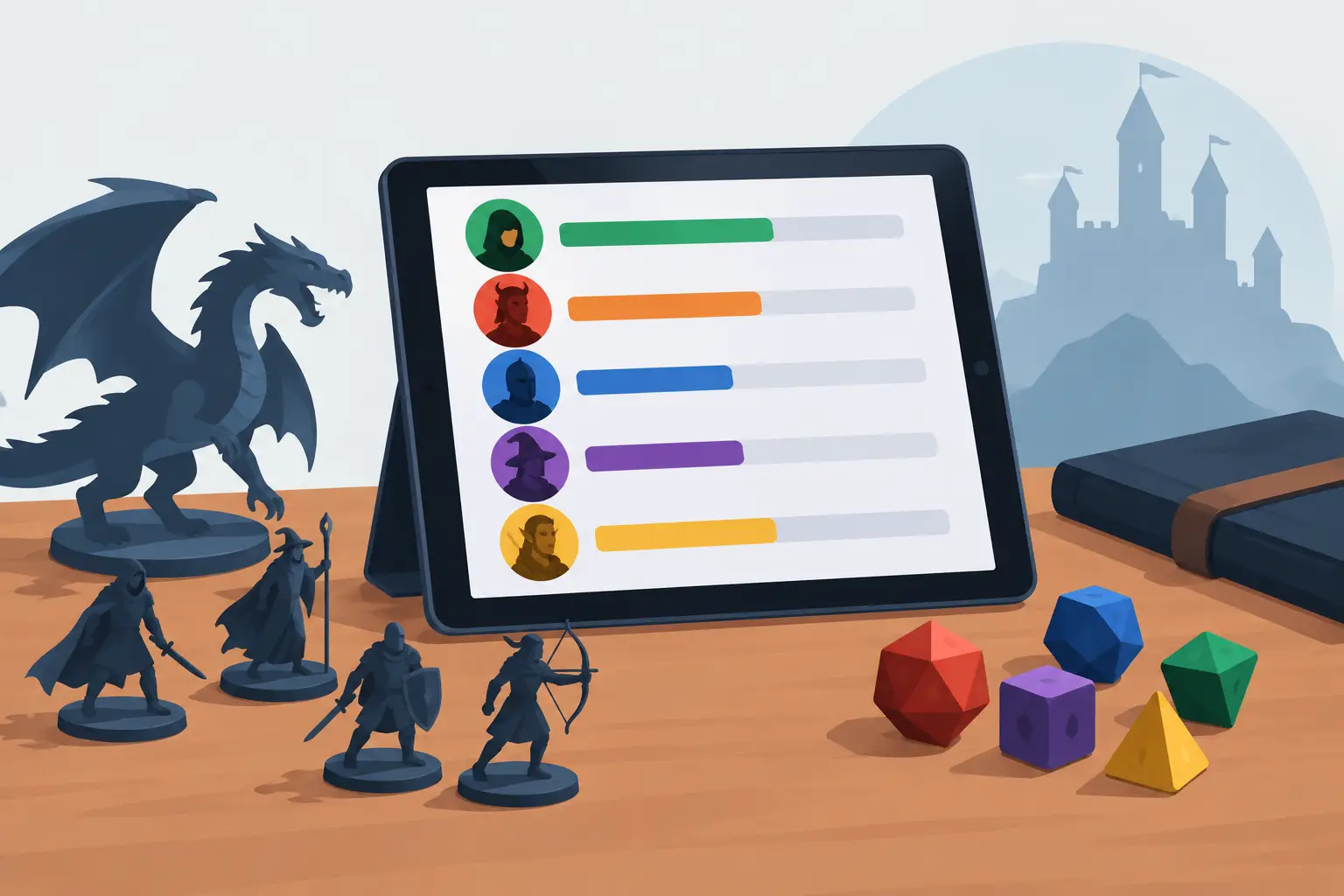
The best D&D initiative trackers do one gloriously unglamorous job: they stop the party asking, “Wait, who’s next?” for the fourth time before the goblins have even had a turn. Combat has enough chaos already. Your barbarian is rage-screaming, the wizard is measuring a fireball radius with alarming confidence, and somebody has misplaced their pencil. Initiative should not be the final boss.
The right tracker depends on how your table plays. A dramatic, miniatures-heavy dungeon crawl needs something different from a cosy sofa campaign with character sheets balanced on knees. Here are the initiative options worth putting on the table, from humble paper to proper goblin-made gaming kit.
What Makes the Best D&D Initiative Trackers?
A useful initiative tracker must be visible, quick to update and difficult to accidentally destroy with a mug of tea. It should show turn order at a glance, but ideally it also keeps the Dungeon Master from losing track of conditions, concentration, legendary actions and the villain who has somehow become invisible again.
There is no single best choice for every group. Digital tools are brilliant for online games and encounter-heavy campaigns, while physical trackers suit in-person tables because everyone can see the order without peering at the DM’s laptop. The best version is the one your group will actually use every session, not the cleverest contraption in the realm.
1. Initiative cards: the classic low-cost workhorse
Index cards or folded tent cards remain one of the smartest options for an in-person game. Write each character and creature name on a card, add their initiative result, and arrange them in order. If you fold cards over a DM screen, players can see when their turn is approaching while you keep useful monster notes on your side.
This method is wonderfully flexible. You can jot down armour class, passive Perception, spell save DC or the cleric’s current concentration spell without announcing it to the entire room. It also costs practically nothing, which leaves more budget for the important things, such as dice with tiny mushrooms inside them.
The drawback is maintenance. Cards get bent, lost, scribbled on and occasionally adopted by the table cat. Keep a small dedicated set in your campaign folder and they will serve you well.
2. Magnetic trackers: ideal for a shared battle station
A magnetic initiative board looks tidy, feels satisfyingly tactile and handles changing turn orders with minimal faff. Move magnets into place after everyone rolls, then slide a marker along the row as turns pass. Some boards let you include condition magnets, which is a gift when half the room is poisoned, restrained or convinced they are a wolf.
Magnetic trackers are particularly good for groups that play at the same table regularly. They create a clear visual focal point, so nobody needs to interrupt to check whether they have missed their turn. They are also easier to read from a distance than a scribbled notepad tucked behind a screen.
Choose this style if presentation matters to your table. A plain whiteboard does the job, but a tracker with fantasy styling, colour-coded markers or a suitably sinister frame makes combat feel like part of the adventure rather than an admin meeting.
3. 3D-printed initiative trackers: maximum table presence
For miniature-loving parties, a 3D-printed tracker is often the sweet spot between practical accessory and handsome bit of dungeon décor. These come in many forms: clip-on character tabs for a DM screen, slots for name plates, vertical turn towers, or themed trackers shaped with dragon scales, coffins, spellbooks and other deeply reasonable adornments.
The appeal is obvious. A physical tracker gives initiative a home, rather than making it another loose scrap of paper drifting between dice trays. It also makes a cracking gift for the Dungeon Master who already has every rulebook but still runs combat from a notebook that looks like it survived a swamp.
Look for a design with removable name tags or writable inserts. A tracker that only works for one party size is less helpful when three guests arrive for a one-shot, all named some variation of “Thorn”. If your table likes a little gothic drama alongside its goblin stabbing, this is a fine excuse to give the encounter board some character. Planet Goblin is, naturally, very pro-accessory with questionable manners.
4. Dry-wipe boards: best for flexible encounters
A dry-wipe initiative board is hard to beat for speed. Write names and numbers, erase them after the fight, and start fresh next encounter. It is especially handy for campaigns with shifting rosters, summoned creatures, hirelings, familiars and other small creatures determined to become administratively significant.
A board with columns for hit points, conditions and round count can replace several scraps of paper at once. For DMs who run big combats, that organisation is not glamorous, but it prevents the deeply embarrassing moment when the villain has been “stunned” for five rounds because nobody wrote down when the save happened.
The trade-off is atmosphere. A bright office-style board can look a little less magical beside painted terrain and flickering LED candles. You can fix that with a themed frame, nice markers and handwriting that does not resemble a frightened spider.
5. Combat notebooks: best for DMs who love receipts
Some Dungeon Masters want a record of every encounter: initiative order, monster hit points, treasure awarded, the exact moment the bard derailed the plot. A dedicated combat notebook is excellent for this style of campaign.
Use one page per encounter, with pre-drawn lines for names, initiatives, hit points and conditions. You can prepare likely encounters before the session, then make notes as events go wonderfully wrong. This approach works without batteries, apps or table space, and it travels well for games at a mate’s house or the local gaming club.
It is less visible for players, however. If your goal is to help everyone plan their turns, pair the notebook with simple tent cards or a small public tracker. You retain your precious records; they stop asking if they are after the owlbear.
6. Digital initiative trackers: best for online and high-detail play
For virtual games, a digital tracker is usually the sensible answer. Most virtual tabletops have initiative built in, and standalone apps can automate sorting, recurring monsters, round counts and condition reminders. That is a genuine blessing for complex encounters involving lair actions, multiple enemy types and a druid who has become something with too many hit points.
Digital tools also shine when you want to hide enemy initiative or track health privately. They can calculate quickly and reduce arithmetic errors, which is handy when combat involves twenty creatures and one of them has resistance to whatever damage type everyone remembered differently.
But screens can make an in-person table feel less social. If every player is staring at a device, the battle can lose some of its theatrical buzz. Consider putting the public turn order on a shared tablet or television while keeping the finer details on your own device.
7. Miniature-based turn markers: best for visual storytellers
If you already use battlemaps and miniatures, small turn markers can make the active creature obvious without another board. A coloured ring, token, clip or standee placed beside the current miniature keeps eyes on the action. Add a second marker for the next player and you encourage people to prepare before their turn begins.
This option does not replace a full initiative list, especially in larger fights, but it works beautifully alongside one. It is fast, unobtrusive and very satisfying when the marker slides from hero to monster to hero as the battlefield changes.
How to Choose an Initiative Tracker for Your Group
Start with your table size. For three or four players, cards or a notebook may be all you need. For six players plus monsters, a visible board or 3D-printed tracker quickly earns its keep. The more names involved, the more valuable a shared display becomes.
Then think about your campaign’s habits. If conditions regularly pile up, choose something with tokens, magnets or room for notes. If you run one-shots with different friends each month, dry-wipe surfaces and reusable labels are kinder than making personalised cards. For online games, prioritise a tool that your players can read without needing a second degree in button pressing.
Finally, allow for joy. Tabletop accessories do not need to be purely sensible. A tracker that fits your necromancer’s crypt, witchy cottage campaign or heroic dragon-hunting party can make people more excited to sit down and play. That matters. The best table tools are the ones that quietly solve a problem while making the whole table feel more like yours.
Choose the tracker that makes initiative disappear into the rhythm of the game, then spend the saved minutes on the part everyone remembers: the improbable plan, the dreadful dice roll, and the goblin who absolutely did not deserve a name but has one now.