
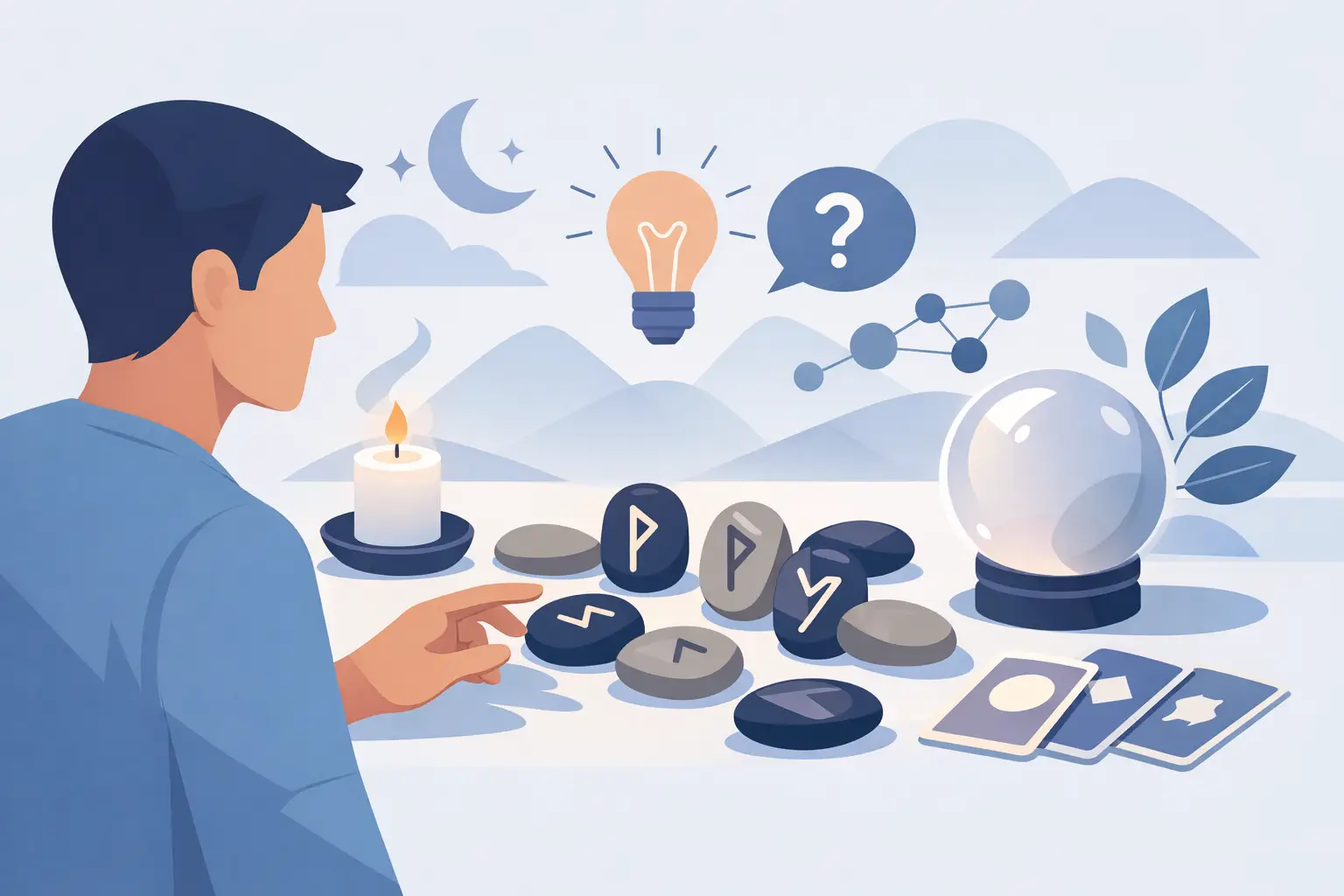
A rune pouch is not a tiny bag of guaranteed answers from the universe. It is better than that: a tactile way to sit with a question, notice what is already stirring in your brain, and give your intuition something ancient-looking to argue with. If you want to read rune stones, start with curiosity rather than the pressure to become an all-knowing forest oracle by teatime.
Runes can be spiritual tools, historical alphabets, beautiful objects for a witchy shelf, or all three at once. The useful bit is learning what your set means to you, where its tradition comes from, and how to read without turning every awkward Tuesday into a cosmic emergency.
What rune stones are actually for
The word “rune” refers to characters used in several historical Germanic writing systems. The best-known set for modern rune reading is the Elder Futhark, a 24-rune alphabet used roughly from the second to eighth centuries. Its name comes from the sounds of its first six runes: F, U, Th, A, R and K. Very handy, very old, considerably less like a fantasy film prop than social media would have you believe.
Modern divinatory rune meanings are a blend of historical scholarship, later folklore and contemporary spiritual practice. That does not make a personal reading meaningless. It does mean there is no universally approved booklet, no rune police kicking down your door because you interpreted Raidho as a nudge to reconsider a journey.
Many readers use rune stones for reflection. You might ask what energy surrounds a decision, what you are overlooking in a friendship, or where to direct your efforts in a creative project. A rune is not a court order. Treat it as a prompt, not a command.
Choose a set you will actually use
Your first set does not need to be carved from a storm-felled ash tree by a suspiciously handsome Viking. Wooden, stone, glass, clay and resin rune sets all work perfectly well. The material changes the feel of the ritual more than the quality of the reading.
Smooth stones are satisfying to handle and feel properly earthy. Wooden runes are light, warm and often easier to carry. A highly decorative set can make a brilliant gift, but check that the symbols are clear enough to read in low light. Black-on-black gothic drama is excellent until you are squinting at a rune like it owes you rent.
For beginners, an Elder Futhark set with the 24 traditional symbols is the simplest place to begin. Some modern sets include a blank stone, often called Odin’s Rune or Wyrd. This is not part of the historic Elder Futhark, so decide whether you want to use it rather than assuming it is compulsory. Leaving it out is entirely valid. Bramble has issued no decree on the matter, mostly because Bramble enjoys plausible deniability.
Keep your runes in a pouch, box or little dish where they will not disappear under a pile of dice and mysterious receipts. If you like cleansing rituals, you can pass them through incense smoke, place them under moonlight, tap the pouch, or simply tidy your reading space and take a breath. Intent matters more than theatre.
Learn the symbols before you cast
You do not need to memorise every rune before your first reading, but building familiarity makes the experience far more rewarding. Start with a small group and add more as they settle in your mind. Write down the rune’s name, sound, traditional associations and your own observations.
For example, Fehu is often linked with movable wealth, resources and momentum. That does not automatically mean a winning lottery ticket is cantering towards you. It may point to time, energy, money, skills, or the need to use what you already have wisely.
Uruz is frequently associated with strength, endurance and raw potential. Thurisaz can suggest boundaries, friction or decisive force. Ansuz is commonly connected with communication, learning and messages. These meanings are starting points, not tiny cages. Context changes everything.
A good rune journal helps you spot how symbols show up in your life. After each reading, note the question, the runes drawn, your first reaction and what happened later. Do not rewrite the result to make yourself look psychic. The messy entries are where you learn.
Read the rune, then read the question
Suppose you ask, “What should I know about applying for this job?” and draw Ansuz. Communication may be the obvious theme: polish the application, ask a useful question, prepare for the interview. But it could also suggest listening carefully or seeking advice from someone experienced.
Now ask, “What is affecting my friendship?” The same rune might point towards an overdue conversation, mixed messages or a need to say what you mean. The stone has not changed. The question has. This is why copying a keyword from a guidebook and declaring the matter solved is a bit like rolling one D20 and announcing you have completed the campaign.
How to read rune stones with a simple one-rune draw
The one-rune draw is ideal for daily reflection and for anyone who does not fancy scattering stones across the carpet before breakfast. Hold your question in mind. Keep it open enough to invite thought, but specific enough to be useful. “What would help me handle today well?” is better than “Tell me everything.” The universe has admin to do.
Shake the runes gently in their pouch and draw one. Look at the symbol before reaching for the book. What catches your attention? Does its usual meaning feel encouraging, challenging, oddly relevant, or completely baffling? Give yourself a minute with that first response.
Then consult your notes or reference guide. Connect the rune to the question and end with one practical action. If you draw Jera, often linked with cycles, harvest and earned results, your action might be to keep tending a long-term goal rather than demanding instant proof that it is working.
This final step prevents readings becoming decorative fog. Reflection is lovely. Reflection that helps you send the email, rest properly, practise the spell, set the boundary or finish the project is even better.
Try a three-rune spread when you need context
When one rune feels too brief, draw three. Keep the positions straightforward: situation, challenge and advice. You can lay them from left to right, then consider how their themes speak to one another.
Imagine you draw Raidho for the situation, Isa for the challenge and Kenaz for advice. Raidho can suggest movement, direction or a journey. Isa is often linked with stillness, delay or blockage. Kenaz can evoke illumination, knowledge and the controlled fire of creativity. Together, that might suggest you know where you want to go, are frustrated by a pause, and need clearer information or a renewed skill before pushing ahead.
Notice the difference between that and saying, “Travel will be delayed because the stones said so.” One is a useful interpretation. The other is how you end up blaming a pebble for missing the train.
For a more free-form approach, use a rune cast. Take a small handful from the pouch and scatter them onto a cloth. Runes near the centre may feel most relevant; those at the edge may point to background influences. Their orientation and proximity can add texture. Casts are wonderfully atmospheric, but they are harder to interpret when you are new. Begin with one- and three-rune readings, then get gloriously complicated later.
Do reversed runes matter?
Some readers use reversed or merkstave meanings. Others read every rune upright, arguing that a rune’s difficult expression can be understood through the question and surrounding stones. Both approaches are common.
If you use reversals, avoid treating them as a simple opposite. A reversed Gebo, a rune often associated with gifts, exchange and reciprocity, might suggest an imbalance in giving and receiving. It does not necessarily mean “bad gift”. A reversed rune can indicate delay, resistance, an internalised version of the theme, or a warning to look closer.
Consistency matters more than choosing the supposedly correct system. Decide your approach before a reading, record it in your journal and give yourself time to see whether it produces thoughtful results.
Keep your practice respectful and useful
Runes have histories beyond their current witchy, fantasy-friendly popularity. Learn about the cultures and periods that used them as writing systems, and be cautious with symbols that have been hijacked by extremist groups. Context matters. If a rune appears in hateful imagery, that does not erase its history, but it does call for awareness and care.
It is also wise to set boundaries around what you ask. Do not use rune readings to make medical, legal or financial decisions, and do not treat them as proof of what another person secretly thinks or will do. Reading for someone else works best with their consent and with questions centred on their choices, not on spying into their private life.
A thoughtful question might be, “How can I show up well in this relationship?” Less thoughtful: “Will my ex crawl back by Thursday?” The stones deserve better. Frankly, so do you.
The most compelling rune practice is not the one with the darkest candlelight or the most dramatic pouch. It is the one you return to honestly. Pick a rune, sit with it, write down what it stirs, and let that small strange symbol help you notice your next useful move.