
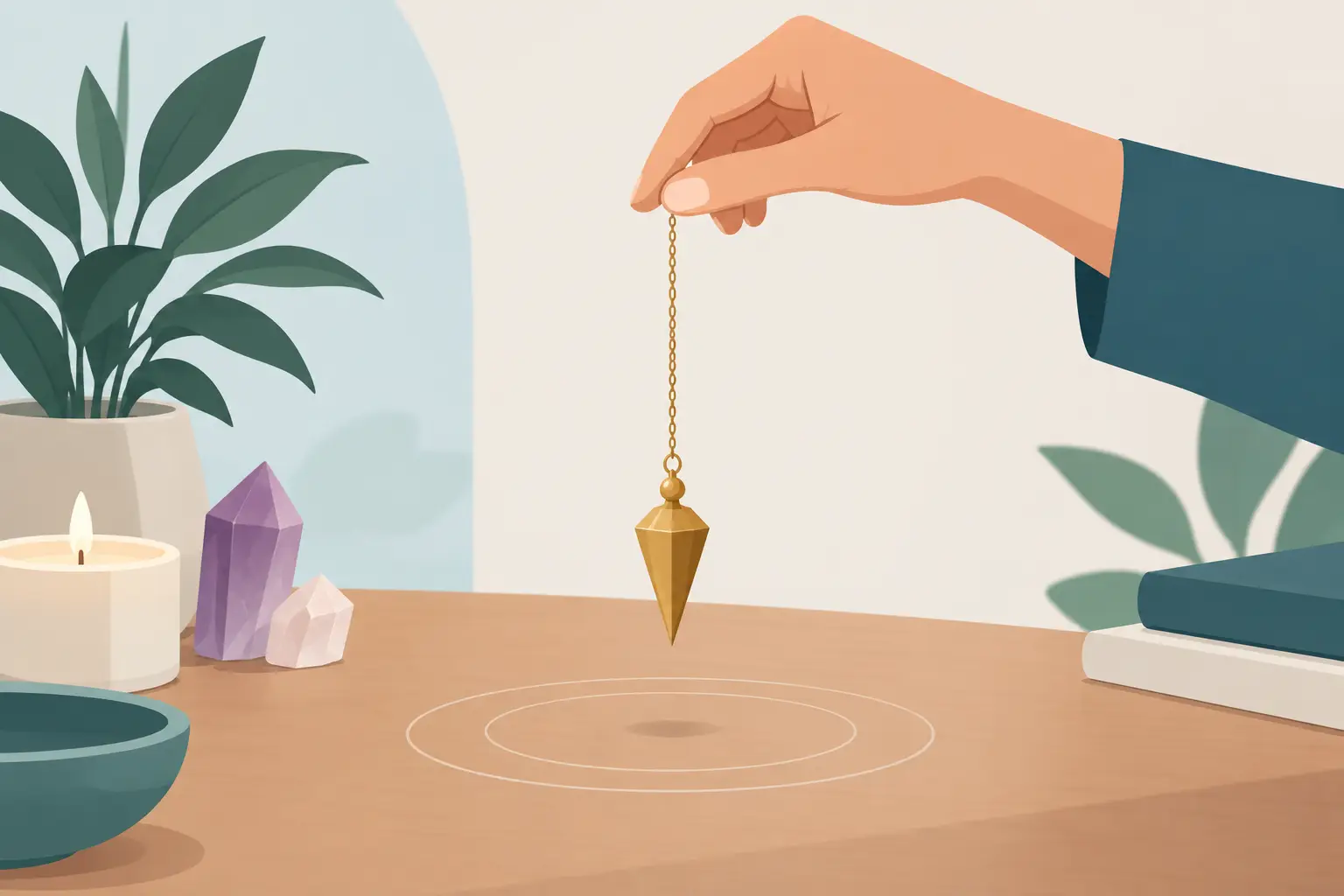
A pendulum does not need a velvet-lined altar, a thunderstorm, or a dramatic declaration from the cat to be useful. Learning how to use a pendulum starts with a small weight on a chain, a quiet moment, and enough honesty to accept that your own thoughts may be part of the answer.
For some people, pendulum work is a spiritual practice used alongside tarot, oracle cards, meditation, or ritual. For others, it is a reflective tool that helps them notice what they already feel. Both approaches are perfectly respectable. The little dangling object is not here to run your life, sack your GP, or decide whether you should text your ex at 2am. It is a prompt, not an all-knowing cosmic manager.
What a pendulum is actually for
A pendulum is a weighted object suspended from a chain, cord, or string. When held still, it can begin to swing, circle, or move in a particular direction. In divination, those movements are interpreted as answers to clear questions.
There are spiritual explanations for this: guidance from intuition, spirit, deity, ancestors, or energy. There is also a practical explanation called the ideomotor effect, where tiny unconscious muscle movements influence the pendulum. These do not have to be enemies. If your unconscious mind has noticed something your overthinking brain is busily ignoring, a pendulum can make that reaction easier to see.
The best use for a pendulum is not predicting lottery numbers or outsourcing every decision you possess. It is most helpful for checking in with yourself, focusing an intention, or adding structure to a personal spiritual practice. Think less enchanted answer machine, more mystical compass with occasional goblin interference.
How to use a pendulum: set up your signals first
Before asking anything meaningful, establish what each movement means. This is the bit newcomers often skip, then wonder why their pendulum seems to be giving them a cryptic interpretive dance.
Choose somewhere reasonably calm. Sit with both feet on the floor or stand comfortably, relax your shoulders, and rest your elbow on a table if that helps keep your hand steady. Hold the chain between your thumb and forefinger, leaving enough length for the weight to swing freely. Around 10 to 15 centimetres is a good starting point, but there is no sacred measuring tape being wielded by the moon.
Take a few slow breaths. You may like to cleanse the pendulum in a way that suits your practice: with incense smoke, sound, moonlight, a visualisation, or simply a clear spoken intention. Be mindful with delicate crystals and water, salt, or direct sunlight, as some materials can be damaged or fade.
Then say, either aloud or in your head: “Show me yes.” Wait without forcing it. Your pendulum may move back and forth, side to side, clockwise, or anticlockwise. Notice the movement. Next, ask it to show you “no”, then “maybe” or “unclear”.
Repeat this a couple of times. The directions do not need to match a diagram you saw online. A clockwise circle is not universally yes just because somebody on social media said so with suspicious confidence. Your established signals are what matter for that session.
Test with simple facts
Once you have signals, try questions where you already know the answer. “Is my name [your name]?” should produce yes. “Am I currently wearing a hat?” is useful if you are, in fact, not wearing a hat. Keep it simple and emotionally neutral.
If the answers are muddled, do not panic or accuse the pendulum of betrayal. Your hand may be tense, you may be tired, or you may simply need to slow down. Put it down, reset, and come back later. Divination is allowed to be a bit ordinary sometimes.
Ask questions a pendulum can answer
Pendulums work best with focused questions that can be answered by yes, no, or unclear. Vague questions invite vague movement. “What should I do with my entire future?” is quite a lot to place on a small crystal bob.
Instead, break a big concern into smaller questions. If you are considering a new creative project, you might ask: “Would working on this idea this week feel energising?” or “Am I avoiding this because I am nervous rather than uninterested?” The latter may reveal more than asking whether the project is destined for glory.
Phrase questions as clearly and neutrally as you can. Avoid stacking several questions into one, such as “Should I buy this, quit my job, and move to Cornwall?” Also watch for loaded wording. If you desperately want a yes, your body may nudge the answer in that direction before the pendulum has even had a chance to waggle.
A useful trick is to ask the same question from two angles. “Would this option support me right now?” followed by “Would waiting a week give me more clarity?” can help you notice whether you are seeking permission or genuinely checking in.
Use an ‘unclear’ answer properly
An unclear response is not a failure. It may mean the question is badly phrased, you do not have enough information, the timing is off, or you are too emotionally invested to get a calm read. Occasionally, it means you need a snack and a lie-down. Mysticism and basic human maintenance coexist beautifully.
When you get an unclear answer, reword the question once. If it remains unclear, stop. Research the practical facts, journal about the decision, talk to someone you trust, or return another day. Pestering a pendulum until it says what you wanted is not spiritual insight. It is just arguing with jewellery.
Choosing a pendulum that you will actually use
You can use a crystal pendulum, a metal one, a piece of jewellery, a key on a string, or any balanced object that hangs and swings freely. Crystal pendulums are popular because people connect different stones with particular intentions: amethyst for calm, rose quartz for compassion, clear quartz for clarity, and so on. Choose what feels meaningful, but do not let crystal lore turn into a shopping stress spiral.
Weight and shape matter more than people expect. A pendulum that is too light may react to every breath; one that is very heavy can feel sluggish. A pointed shape can be easier to read over a chart, while a rounded stone has a softer, classic look. Chain length is personal, too. The best one is the pendulum you feel comfortable holding, not the one that has been photographed next to seventeen dried roses and a raven skull.
If you are buying one as a gift, consider the recipient’s style. A dark metal pendulum suits a gothic altar beautifully; a colourful stone may feel more inviting for a beginner; and a subtle necklace-style design is ideal for someone who prefers their witchy bits a little less obvious at the office.
Try a pendulum chart, but do not become its employee
A pendulum chart is a printed or drawn guide with labelled sections such as yes, no, maybe, timing, letters, numbers, or emotions. Holding the pendulum above the centre can make answers easier to interpret, especially if circular movements are hard to distinguish.
For beginners, a simple chart is enough. Use yes, no, unclear, and perhaps “not now”. Complicated alphabet charts can be fun, but they are slow and leave plenty of room for wishful interpretation. If you want detailed guidance, tarot, journalling, or an honest conversation may serve you better.
You can make a chart in your notebook and decorate it with moons, mushrooms, dragons, tiny swords, whatever makes your strange little heart happy. The purpose is focus, not visual perfection. Bramble would like it known that a chart covered in glitter still counts, though your carpet may file a complaint.
Keep your practice grounded
A pendulum can be a lovely part of a spiritual routine, but it has limits. Do not use it for medical, legal, financial, or safety-critical choices. If you are worried about your health, contact an appropriate professional. If a relationship feels unsafe, prioritise real-world support and safety planning over any divination result.
It is also worth taking breaks if pendulum work starts making you anxious or dependent on constant reassurance. You are still allowed to choose without receiving a sign. In fact, choosing while uncertain is one of the more irritatingly human skills we get to develop.
Try ending each session by thanking whatever you work with – your intuition, your guides, your own reflective mind – then place the pendulum somewhere safe. A pouch, box, or dedicated altar space helps prevent it becoming tangled in the bottom of a bag with three receipts and a mystery biscuit.
The next time a question is circling your mind, let the pendulum slow you down rather than rush you towards an answer. Hold it lightly, ask clearly, and leave room for your own judgement to have the final say.