
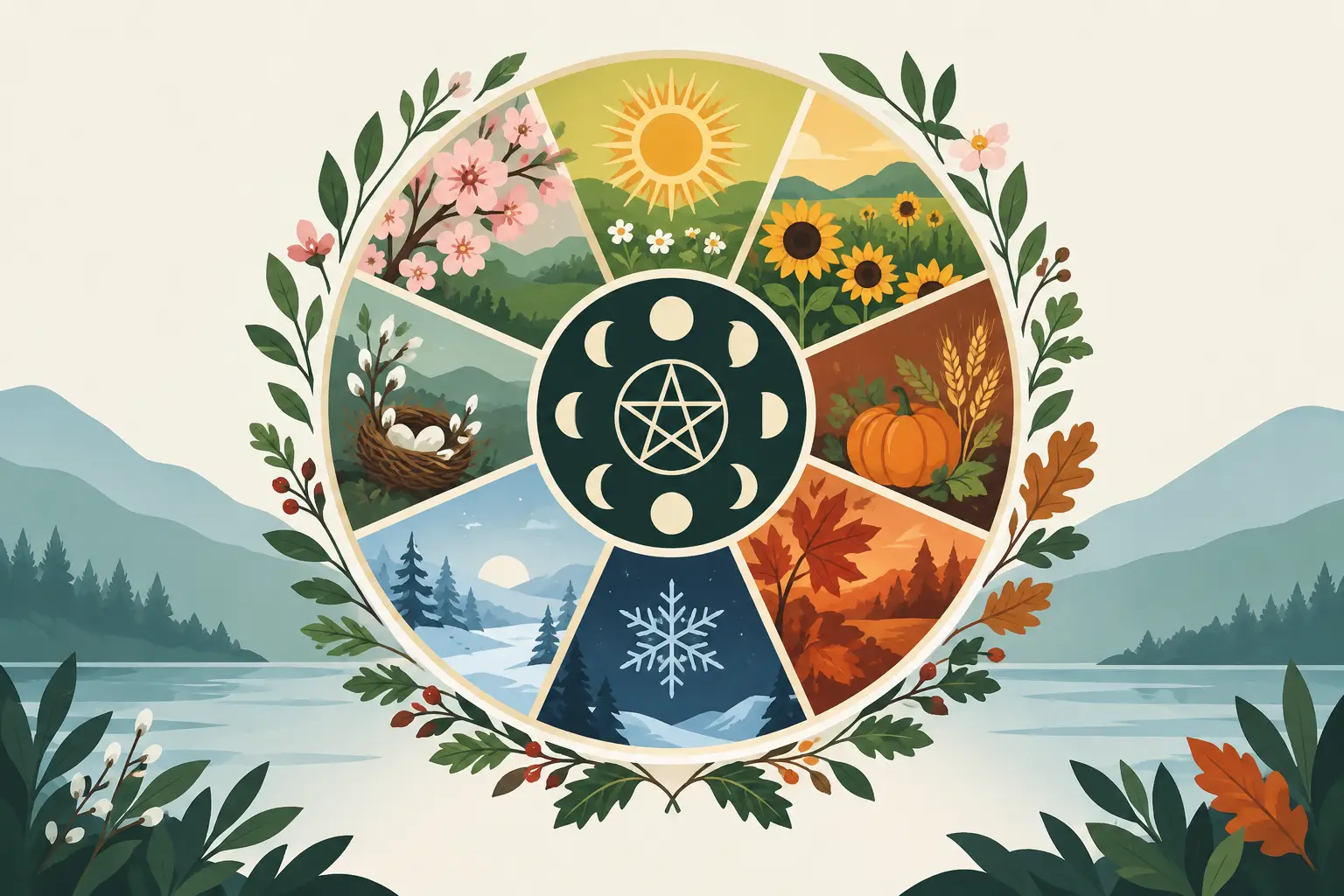
The first snowdrops appearing beside a damp pavement, a bonfire that smells like someone has summoned the entire neighbourhood, blackberries staining your fingers in August – the pagan year is not a tidy set of dates in a diary. It is a way of paying attention. This pagan festival calendar guide follows the eight festivals commonly called the Wheel of the Year, with a distinctly UK eye on the weather, the light and the muddy reality of living somewhere that can offer sunshine, hail and a dramatic sky before lunch.
For many modern Wiccans and pagans, these festivals are sabbats: moments to mark seasonal change, honour deities or ancestors, gather with a community, or simply make a decent cup of tea and reflect. Your practice can be elaborate, private, devotional, secular, traditional or gloriously goblin-made. There is no prize for having the most candles.
The Pagan Festival Calendar at a Glance
The Wheel of the Year has four solar festivals and four cross-quarter festivals. Solar dates may shift slightly from year to year, while the cross-quarter dates are often observed on traditional fixed dates. In the Northern Hemisphere, the usual calendar looks like this:
| Festival | Usual date | Seasonal thread | |—|—:|—| | Yule | 21-22 December | Return of the light | | Imbolc | 1 February | First stirrings of spring | | Ostara | 20-21 March | Balance and growth | | Beltane | 1 May | Fertility, fire and abundance | | Litha | 20-21 June | Height of summer | | Lughnasadh | 1 August | First harvest | | Mabon | 21-23 September | Harvest and balance | | Samhain | 31 October | Ancestors, endings and winter |
Some people celebrate on the nearest weekend, on an astronomical date, or when the season actually arrives where they live. That last option is entirely sensible. If your garden is still frozen on 1 February, nobody from the Cosmic Administration is coming to confiscate your altar cloth.
Winter: Yule and Imbolc
Yule – the solstice and the returning sun
Yule falls at the winter solstice, usually around 21 or 22 December. It marks the longest night and the gradual return of daylight. In Britain, where darkness seems to arrive at 3.47 pm and refuse to leave, that promise can feel wonderfully practical.
Yule celebrations often involve candles, evergreens, seasonal food, gift-giving and a focus on warmth. You might decorate a small altar with pine, holly, dried orange slices or a gold candle. Some practitioners honour the sun’s rebirth; others keep it simple and use the occasion to recognise what carried them through a difficult year.
There is a difference between drawing inspiration from seasonal customs and claiming every winter tradition as ancient pagan fact. Modern practice can still be meaningful without a made-up history lesson stapled to it.
Imbolc – the first spark of spring
Observed on 1 February, Imbolc is associated with early spring, cleansing, inspiration and the Irish goddess Brigid in many traditions. It is a festival of beginnings that are not yet photogenic. The bulbs are trying. You are trying. The kettle is doing most of the spiritual heavy lifting.
A fitting Imbolc ritual might involve cleaning your space, refreshing altar items, writing intentions for the months ahead or lighting a white candle safely. If you work with Brigid, take time to learn about her Irish context rather than borrowing symbols with the subtlety of a dragon kicking through a bookshop window.
Spring: Ostara and Beltane
Ostara – balance, eggs and new growth
Ostara takes place at the spring equinox, around 20 or 21 March, when day and night are close to equal. Many modern pagans celebrate growth, balance and renewal with eggs, seeds, flowers and pastel colours. The festival is often linked to a goddess named Eostre, although the historical evidence is limited, so it is worth treating that connection thoughtfully rather than as unshakeable fact.
This is a lovely time to plant something, even if it is just basil on a windowsill with wildly optimistic expectations. Consider what needs more light, attention or patience in your life. Then apply that thought to a real action, because intentions are more useful when they occasionally get their boots on.
Beltane – bright fire and full blossom
Beltane, on 1 May, is a festival of vitality, pleasure, fertility and protection. Traditionally associated with fires and the opening of summer, it is often celebrated with flowers, ribbons, music and a sense of being very much alive.
You do not need to leap over a bonfire to observe Beltane. Frankly, most gardens are not insured for that sort of confidence. Make a flower crown, decorate your home with safe seasonal greenery, share food with friends or light a candle while thinking about creative energy, connection and what you want to invite in. Consent, safety and common sense remain magical at all times.
Summer: Litha and Lughnasadh
Litha – honouring the longest day
Litha, or Midsummer, falls around 20 or 21 June at the summer solstice. It celebrates the sun at its peak: warmth, confidence, abundance and the fullness of the growing season. It also carries a quieter truth. From this point, the days slowly begin shortening again. The Wheel is always turning, even at the height of the party.
Spend time outdoors if you can, gather wildflowers only where it is permitted, and enjoy seasonal fruit. A sunrise walk, a sun-themed tarot or oracle pull, or a meal with favourite people all work beautifully. Stone circles and sacred sites deserve particular care: follow local rules, leave no trace and do not treat a historic place like a content backdrop.
Lughnasadh – the first harvest
Lughnasadh, also called Lammas, arrives on 1 August. It is a first-harvest festival associated with grain, bread, craft, sacrifice and the Celtic god Lugh in some traditions. The word “sacrifice” need not mean anything theatrical. It can mean recognising what you must set aside to finish a project, learn a skill or make room for something worth growing.
Bake bread, visit a local market, thank the people and land involved in producing your food, or make something with your hands. This is an excellent sabbat for creative work, whether that means painting, knitting, writing, building terrain for your next tabletop campaign or finally organising the dice that have colonised your desk.
Autumn: Mabon and Samhain
Mabon – gratitude without forced positivity
The autumn equinox, around 21 to 23 September, is often called Mabon in modern pagan practice. It is a second harvest celebration centred on balance, gratitude and preparation. Not every tradition uses this name, and it is a relatively modern label, but the seasonal moment is no less useful for reflection.
Take stock of what has come to fruition and what has not. Gratitude does not mean pretending everything is perfect. It can mean noticing a good friend, a warm coat, a finished task or a decent apple while acknowledging that life is currently being a bit of a gremlin.
Samhain – the threshold of the year
Samhain, observed on 31 October, is often considered the pagan new year in modern Wiccan and pagan traditions. It is associated with death, ancestors, endings and the thinning of boundaries. It is not “pagan Halloween” in a disposable fancy-dress sense, though the two share seasonal territory and can coexist quite happily.
Create an ancestor space with photographs, names or offerings that are appropriate to your own heritage and practice. Cook a family recipe, write down what you are ready to release, visit a grave respectfully, or hold a quiet ritual for those you miss. If ancestral work feels complicated or painful, you are allowed to focus on chosen family, beloved pets, cultural ancestors or the simple turning of the season instead.
Make the Wheel Yours, Respectfully
A calendar is a prompt, not a test. Start with one festival that genuinely speaks to you, rather than panic-buying half a forest’s worth of supplies for all eight. A candle, a notebook, a seasonal meal or a walk can be enough. If tools help you focus, choose items you will actually use: an altar cloth, a journal, a deck, a small cauldron, or a candle holder with just enough gothic drama to satisfy your inner crypt keeper. Planet Goblin is, naturally, suspiciously well stocked for the latter.
Be careful with claims of ancient certainty, especially online. Paganism includes many living paths with different beliefs, cultures and practices. Wicca is not the same as Druidry; Celtic-inspired practice is not a free-for-all for anyone to rewrite; and spiritual curiosity is best paired with research, credit and respect.
Let the year meet you where you are. Mark the returning light when you need hope, the harvest when you need perspective, and the dark when you need rest. The wheel will turn without your perfect playlist or hand-poured beeswax candles. But pausing to notice it might make the ordinary world feel properly enchanted.