
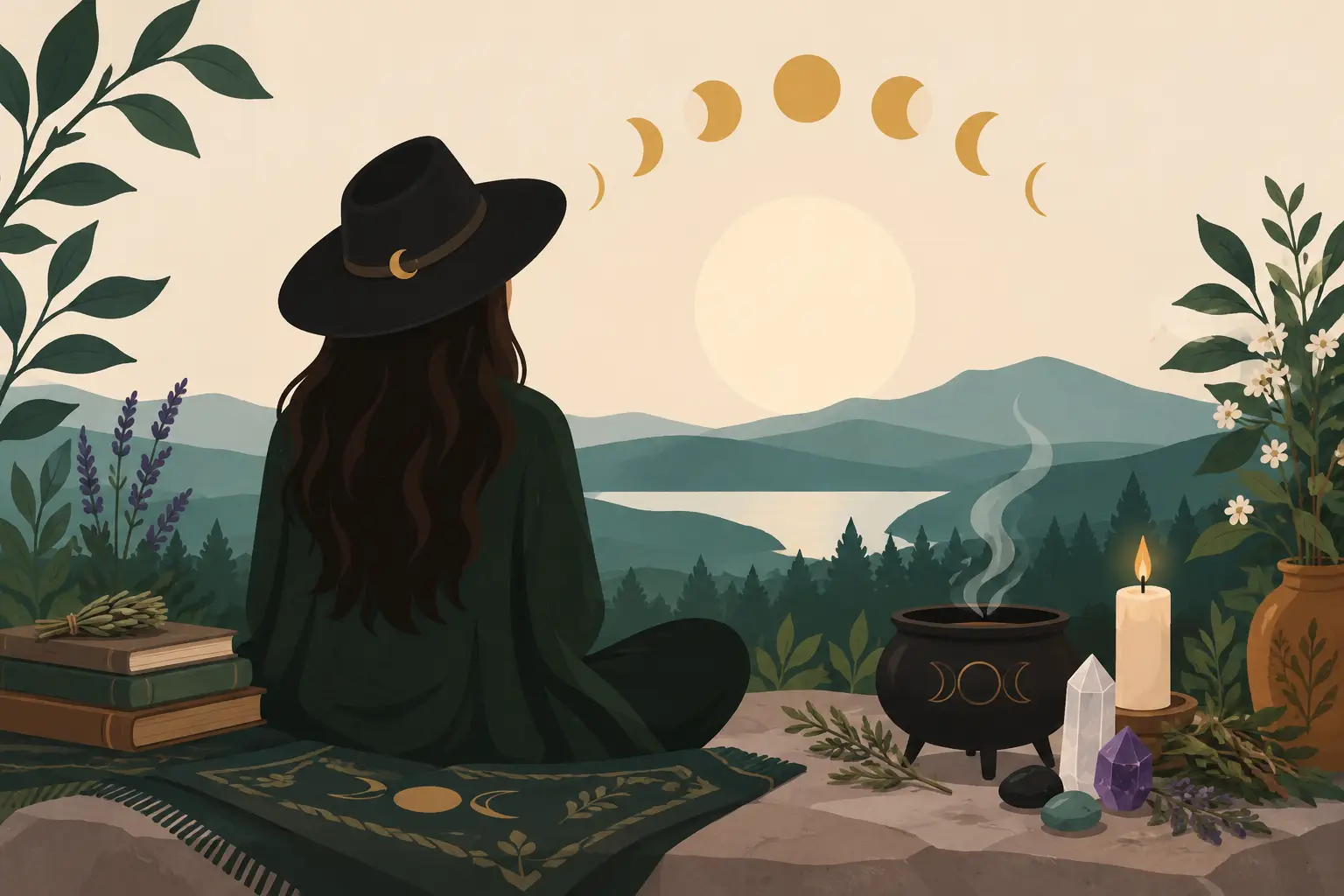
The first thing to know about pagan spirituality is that it does not arrive in a black velvet box with a compulsory candle, a perfect altar and a quiz to prove you are witchy enough. It is a broad family of earth-centred, polytheistic and nature-aware paths, practised in wildly different ways by wildly different people. That variety is not a flaw in the map. It is the map.
For some, pagan spirituality means honouring the changing seasons and marking the Wheel of the Year. For others, it means building relationships with deities, ancestors, spirits or the land around them. Some people practise through formal traditions with clear structures; others follow a solitary path shaped by research, reflection and a great many notebooks. You do not need to pick an aesthetic, buy a forest’s worth of objects or announce yourself to the moon on day one.
Pagan spirituality is not the same as Wicca
Wicca is a modern pagan religion, but it is not a catch-all label for every pagan practitioner. Heathenry, Druidry, Hellenism, Celtic reconstructionism, eclectic paganism and animist paths are just a few branches in a very large, occasionally tangled tree. Some focus on particular historical cultures and gods. Others are more flexible, bringing together practices that feel spiritually meaningful while still treating their origins with respect.
This matters because labels can carry specific beliefs, rituals and responsibilities. Calling every pagan a Wiccan is a bit like calling every tabletop game Dungeons & Dragons. A familiar reference point, perhaps, but not remotely the whole dungeon.
It is also perfectly reasonable to begin without a label. Plenty of people spend months or years reading, observing the seasons and trying small practices before deciding whether a tradition fits. Others never settle on one. Spirituality is allowed to be a work in progress, even if your brain would prefer a colour-coded binder immediately.
Where pagan spirituality often begins
The natural world is a common starting point. Pagan practice may involve noticing the first frost, the return of lighter evenings, a full moon, a local river, a much-loved tree or the slow, stubborn work of a garden. This is not about pretending Britain has endless mystical woodland on tap. A windowsill herb, a walk round the estate or watching rain stripe the glass can be a genuine point of connection.
Seasonal festivals are another accessible route. Many pagans mark Samhain, Yule, Imbolc, Ostara, Beltane, Litha, Lughnasadh and Mabon, though the meanings and dates can differ between traditions. You might light a candle at Yule, make time for a spring clean at Imbolc or cook something seasonal at harvest time. The ritual does not need to be elaborate to be intentional.
Some practitioners work with deities. This can mean prayer, offerings, devotional study or simply learning the stories and cultural contexts connected to a god or goddess. Others do not work with deities at all, instead finding meaning in nature, ancestors, archetypes or personal ritual. Pagan spirituality has room for devotion, scepticism and thoughtful uncertainty. You are not failing because you have not received a dramatic sign from a raven at 3.17pm.
Build a practice before you build an altar
An altar can be beautiful, comforting and useful. It can also become a very expensive shelf for things you feel guilty about not using. Start with practice, then let objects earn their place.
A simple weekly ritual might be ten quiet minutes with a cup of tea and a journal. Note the weather, the moon phase if that interests you, what is changing in your life and what you are grateful for. You could pull an oracle card as a prompt for reflection, meditate with a stone you found on a walk, or light a candle while setting an intention for the week. The point is not to perform spirituality correctly. The point is to create a regular moment of attention.
If you do make a small sacred space, keep it practical. A cloth, candle, bowl, meaningful image, natural object and notebook are plenty. Fire safety is less glamorous than a moonlit ritual, but it remains excellent magic: never leave candles unattended, keep them away from clutter and use a flameless option if your home, pets or landlord demand it.
Tools can support a practice, but they do not create one. Tarot cards, incense, altar cloths, statues and ritual jewellery can be lovely companions, especially when they help you focus or express your identity. They are not entry tickets. The goblin verdict is firm: you may have the shiny thing because it brings you joy, but you do not have to pretend it is spiritually essential.
Research with curiosity and a backbone
Paganism attracts a lot of information, some of it brilliant, some of it wobbly and some of it wearing a flower crown over an alarming amount of misinformation. Be especially cautious of neat claims that an ancient practice was practised exactly one way for thousands of years, or that a social media post can tell you everything about a culture, deity or ritual.
Look for books and teachers who explain their sources, distinguish historical evidence from modern practice and acknowledge uncertainty. Reading more than one perspective is worthwhile, particularly with reconstructionist traditions that aim to revive or adapt the religious practices of specific cultures. History is often incomplete. Respectful practitioners say so rather than filling every gap with confident nonsense and a dramatic font.
It is also wise to learn about closed and initiatory practices. Not every spiritual tradition is available for anyone to adopt, particularly where practices belong to living cultures that have faced colonisation, racism or religious suppression. Appreciation means doing the work to understand context, listening when communities set boundaries and not treating sacred traditions as aesthetic supplies.
That does not mean you must be frightened of getting everything wrong. It means being willing to pause, ask better questions and change course when you learn more. A decent ethical compass is more useful than trying to look mysterious in a woodland photograph.
Ethics are part of the magic
There is no single pagan rulebook, but ethics deserve more attention than they sometimes receive. Think about consent in spellwork involving other people. Consider whether a ritual is helping you act with clarity, or merely avoiding a difficult conversation. Be honest about what divination can and cannot do. Cards can offer a useful lens for reflection; they are not a substitute for medical advice, legal advice, financial advice or calling the actual emergency services.
Care for the environment in ordinary, unglamorous ways too. Do not strip public hedgerows for décor. Do not leave offerings that harm wildlife, such as food, plastic, glitter or objects that will not safely break down. If you gather natural materials, take only what is abundant and permitted. Sometimes the most respectful offering is simply attention.
Community can be a gift, but it needs discernment. A healthy group welcomes questions, respects personal boundaries and does not demand money, secrecy or obedience in exchange for spiritual status. Be wary of anyone claiming exclusive access to truth, threatening bad luck if you leave, or insisting they alone can fix your life. That is not ancient wisdom. That is a red flag with a pentacle doodled on it.
Make room for your own rhythm
The most sustainable pagan practice is one that works with your actual life. You may have a daily devotional routine, or you may only manage a few moments at each sabbat. You might keep your practice private because your household is not supportive. You may be disabled, chronically ill, neurodivergent, a parent, a shift worker or simply knackered. None of that makes you less sincere.
Adaptation is not a lesser version of spirituality. A spoken prayer can become a written one. A woodland walk can become watching birds from a bus stop. A big ritual can become a small bowl of water, a deep breath and a promise to be kinder to yourself this week. The sacred does not vanish because your flat is tiny or your schedule is chaos.
If you are curious, begin with one season, one book, one small act of attention. Let your knowledge grow roots before you decorate it with too many glittery branches. The path does not need to look impressive from the outside. It only needs to feel honest when you return to it.