
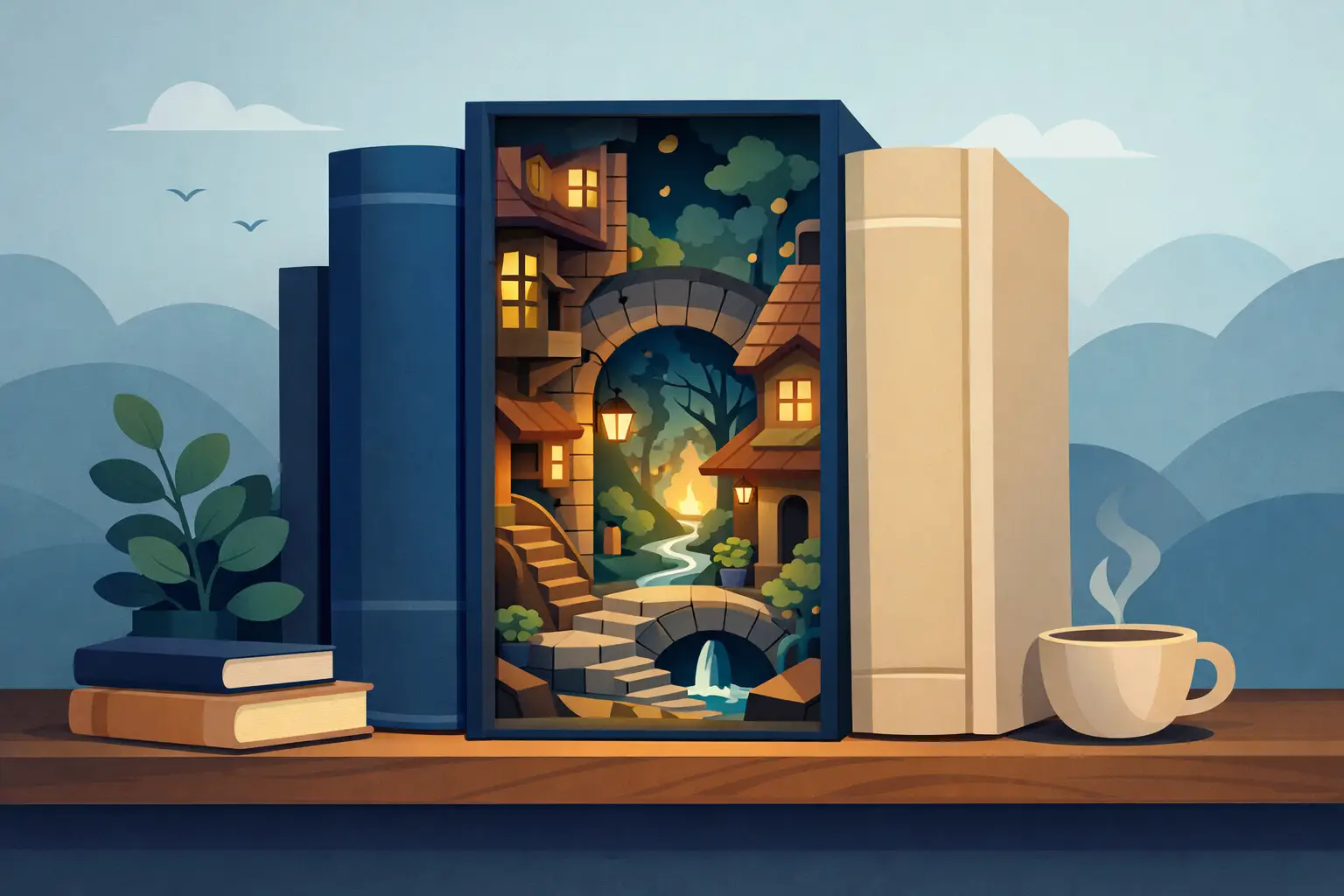
A crowded bookcase has always had a little magic in it, but a book nook gives that magic a postcode. So, what is a book nook? It is a detailed miniature scene made to sit between your books, creating the pleasing illusion that your shelves contain a hidden alleyway, enchanted library, witch’s apothecary or doorway to somewhere much stranger.
They are part model, part décor and part tiny act of world-building. One minute your fantasy paperbacks are behaving themselves; the next, there is a glowing cobbled lane vanishing into the gap between them. Frankly, bookshelves have had it too easy.
What is a book nook, exactly?
A book nook is a narrow diorama designed to fit on a bookshelf. Most are roughly book-shaped from the front, although dimensions vary, and use a boxed structure to frame a miniature setting. The open front lets you peer inside, while a carefully planned backdrop creates depth far beyond the actual space available.
The best designs play tricks with perspective. A small arch, a winding path, layered buildings or shelves lined with teeny books can make a scene look as though it continues for miles. LED lighting is common too, especially in fantasy and gothic styles, where a warm window glow or eerie lantern can turn a shelf into an after-dark spectacle.
Think of it as a doll’s house for people who would rather live in a wizard’s study, a rain-soaked cyberpunk street or a dragon’s library. It does not need to relate to the books around it, but pairing themes is half the fun. A spellbook nook beside your witchy reads, for example, looks intentional. A dungeon passage beside your tabletop manuals looks like the party has wandered off again.
Why book nooks have become collector bait
Book nooks work because they make a practical object feel personal. A bookcase is usually storage. Add one small scene, and it becomes a display of the things you actually love: fantasy, folklore, gaming, gothic architecture, cosy mysteries, anime, strange little creatures with excellent taste in candles.
They also deliver a lot of atmosphere without asking for much room. A full display cabinet is glorious, obviously, but not everyone has the floor space, budget or willingness to dust forty-seven tiny figures every Saturday. A book nook occupies a slim gap and still gives a shelf a focal point.
For collectors, there is another appeal: each one can suggest a larger story. Who lives in that crooked cottage? Why is there a dragon egg in the alley? Why is the shopkeeper definitely selling cursed potions? A good nook leaves room for your own answer. That is more satisfying than décor that merely sits there looking expensive.
The main types of book nook
There is no single official style, which is very much the point. Some book nooks lean cosy, with bookshops, cafés, plant-filled lanes and old libraries. Others go full fantasy with castles, mushrooms, dragons, magical forests and secret portals.
Gothic book nooks tend towards haunted corridors, raven-strewn studies, candlelit crypts and Victorian-looking streets. Witchy designs may feature potion shelves, moon phases, cauldrons or woodland altars. Sci-fi scenes can bring neon cityscapes, spaceship interiors and futuristic streets to the shelf, while fandom-inspired pieces may nod to familiar worlds without needing to shout about it.
Construction matters as much as theme. A ready-made 3D-printed book nook is ideal if you want the finished look without spending an evening locating a microscopic tab that has escaped into the carpet. DIY kits are brilliant for crafters who enjoy the build as much as the result, but they demand patience, steady hands and usually glue. Some arrive pre-painted, while others invite you to paint and customise every last brick.
Neither route is better. It depends whether your ideal hobby evening involves assembling tiny furniture or admiring tiny furniture while eating biscuits.
How to choose a book nook for your shelf
Start with the shelf, not just the aesthetic. Measure the height, width and depth of the space where it will live. It sounds painfully sensible, but a beautiful nook that is two centimetres too tall is still a beautiful nook living on the floor, where it can brood about its wasted potential.
Next, decide what role it should play. If you want a subtle addition among lots of books, choose a design with a strong sense of depth and a colour palette that suits the room. If you want a centrepiece for a collection, go bolder: dramatic lighting, a dragon, a haunted house, perhaps a tiny graveyard. Restraint is a valid choice. It is simply not compulsory in this household.
Consider these details before committing:
- Material and finish: 3D-printed nooks can offer crisp sculpted details and sturdy forms, while wood kits often have a hand-built, layered look.
- Lighting: Check whether LEDs are included, how they are powered and whether the battery compartment will be easy to reach once it is on the shelf.
- Assembly level: Ready-to-display, partially assembled and full DIY kits are very different experiences. Read the description, especially if the gift recipient owns neither craft glue nor patience.
- Depth: A deep nook can look wonderfully immersive, but it needs a shelf with enough clearance and may hide the books behind it.
- Theme longevity: Choose something you will still enjoy after the current trend has shuffled back into the forest. A well-made dragon lair rarely has this problem.
If you are buying for someone else, their existing collection is your best clue. A reader of romantasy may adore an enchanted library. A Dungeons & Dragons player might prefer a dungeon corridor, tavern scene or dice-themed hideaway. For a gothic mate, do not play it safe with beige flowers. They have suffered enough.
Where and how to display one
Book nooks are usually placed between book spines, but they do not have to be squeezed in tightly. Leaving a little breathing room around the sides can make the entrance feel more deliberate and stops nearby hardbacks from scraping painted details.
A solid, level shelf is best, particularly for designs with lighting or delicate add-ons. Keep it away from damp areas and prolonged direct sunlight, which can fade colours over time. If you use LED lights, switch them off when you are not enjoying the effect. Your electricity bill does not need to join the fantasy campaign.
They also look excellent in unexpected places: on a desk between reference books, within a display cabinet, or on a mantelpiece framed by small collectables. Just remember that a book nook is designed to be viewed front-on. Put it too high above eye level and you lose those sneaky perspective details that make it work.
A book nook is more than a reader’s gift
Despite the name, you do not have to be a feral book hoarder to enjoy one. Book nooks make memorable gifts for gamers, miniature collectors, goths, fantasy fans, crafters and anyone whose home could use a suspiciously tiny portal.
They are especially good for people who are difficult to buy for because they combine several pleasures in one object. There is the visual impact, the themed fandom reference, the satisfaction of collecting and, with DIY versions, the activity itself. It feels considered without forcing you to guess someone’s clothing size or pretend they need another novelty mug.
At Planet Goblin, that is exactly why book nooks belong beside dice towers, dragons and other shelf-dwelling oddities. They are expressive little objects for people who prefer their décor to have lore.
Looking after your miniature world
Dust is the natural predator of intricate décor. A soft, dry brush or gentle air blower is usually enough for regular cleaning. Avoid spraying cleaners directly onto the nook, particularly around paint, glued pieces and LED components. For hard-to-reach corners, a clean soft paintbrush is remarkably useful and makes you feel briefly like a professional restorer of ancient magical artefacts.
If your nook contains batteries, check them now and then, especially if it will sit unused for months. Remove them if you are storing it long term. For fragile pieces, move the nook with both hands from the base rather than grabbing an arch, roof or decorative tree. Tiny scenery has limits. Even goblins understand structural engineering when a beloved miniature is involved.
A book nook earns its place because it makes you look twice. Put one where you pass it often, let the lights glow on a gloomy evening, and give your shelf a small, secret world worth coming home to.