
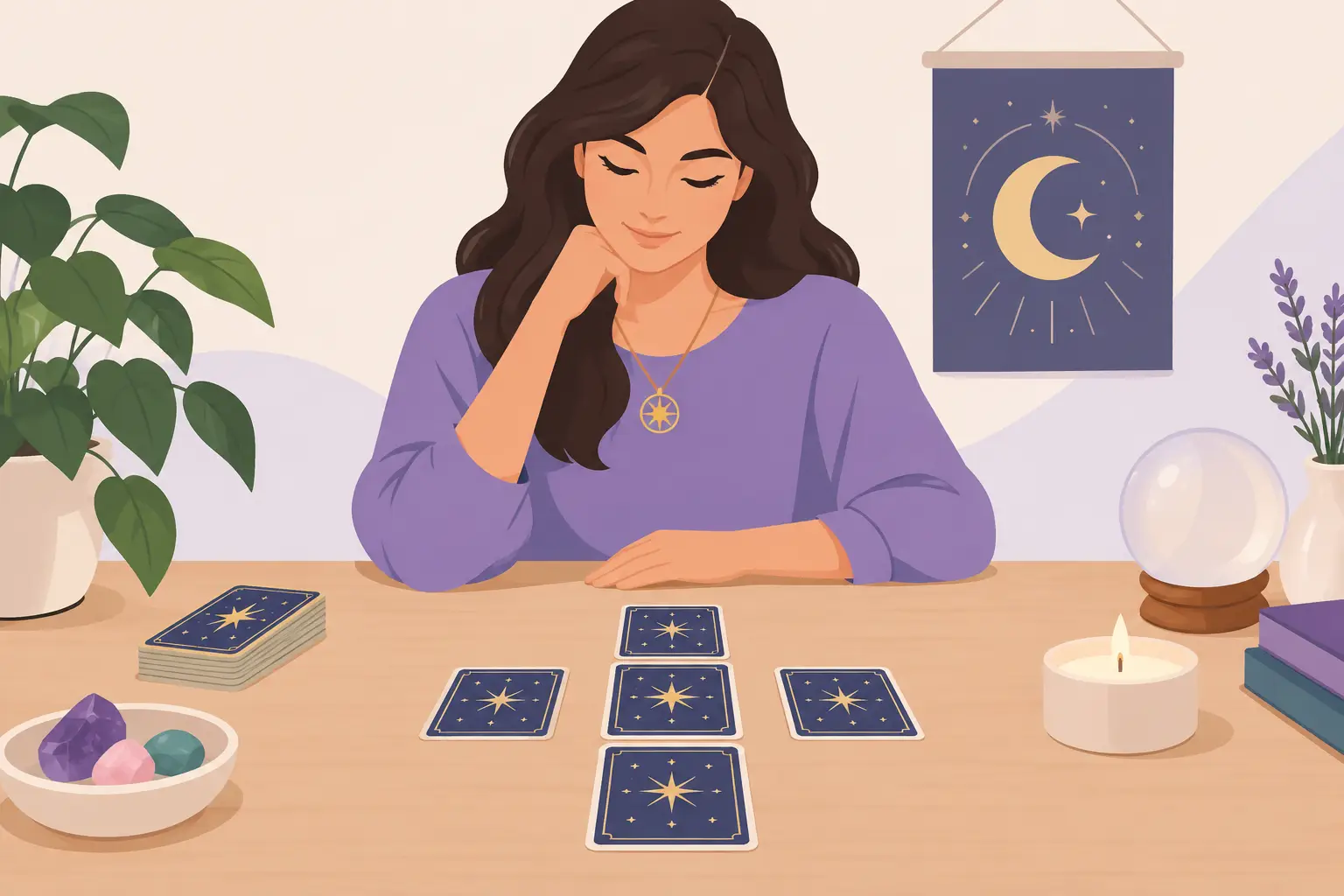
A gorgeous tarot deck can make you feel like you ought to immediately know the mysteries of the universe, preferably while wearing seven rings and staring moodily into candlelight. Rude news from Bramble: you do not. If you are asking which tarot spread is easiest, the answer is the one-card spread. It is quick, clear and far less likely to leave you surrounded by twelve cards wondering why The Tower has turned up next to your biscuit tin.
A simple spread is not a lesser reading. It gives you room to look properly at the artwork, notice your first reaction and learn how a card changes meaning when it meets a real question. Tarot is a language of symbols, stories and instincts. You do not learn a language by attempting a dramatic monologue on day one.
Which tarot spread is easiest? The one-card draw
The easiest tarot spread is one card for one question. Shuffle your deck, hold a question or intention in mind, draw a card and sit with it. That is the whole ritual. No complicated positions, no need to memorise all 78 cards, no elaborate table layout that requires its own postcode.
The power of a one-card draw comes from the question. Avoid vague, panic-flavoured questions such as “What will happen to me?” The deck is not a customer service desk for the entire cosmos. Give it something focused and useful instead: “What energy should I bring to this meeting?”, “What am I overlooking in this creative project?” or “What would help me feel steadier this week?”
Then look before reaching for a guidebook. What is happening in the image? Which colour, person, creature or tiny strange detail catches your eye? Does the card feel like advice, a warning, encouragement or a mirror? Your first impression matters because tarot reading is partly about connecting a traditional card meaning to the moment in front of you.
After that, check the guidebook. Treat it as a helpful goblin companion, not a school marker waiting to declare you Wrong. A card can hold several meanings depending on the question. The Five of Cups might point to grief in one reading, disappointment in another, or a reminder to notice what remains rather than only what was spilled.
A daily card is the best sort of practice
For beginners, drawing one card each morning is wonderfully low-stakes. Ask, “What should I pay attention to today?” Write down the card and one or two thoughts. At the end of the day, return to your notes. Did its theme show up in a conversation, a mood, a choice or something you noticed about yourself?
This builds familiarity without forcing you to learn by rote. You will begin to recognise the feel of cards: the quiet withdrawal of the Hermit, the messy momentum of the Chariot, the gentle practical care of the Queen of Pentacles. Eventually, your deck stops looking like 78 beautifully intimidating strangers.
Do not panic if you pull a so-called scary card. Death usually speaks about endings, change and shedding an old skin, not a literal visit from a cloaked skeleton. The Tower can be disruption, revelation or a structure that was never stable enough to keep. Tarot is dramatic because humans are dramatic. It is not a punishment machine.
When to graduate to the three-card tarot spread
Once a one-card draw feels comfortable, the three-card spread is the next easiest option. It is still beginner-friendly, but gives you a little more story and contrast. Think of it as three goblins trying to explain the same situation from different angles. Occasionally chaotic, often useful.
The classic three positions are past, present and future. This can work well for reflecting on a situation, but it can also make new readers fixate on predicting the future. Tarot is generally more useful when it helps you make choices, spot patterns and understand the energy around a situation. For that reason, try positions that are more practical.
A particularly good spread is: situation, challenge, advice. The first card shows what is most alive in the matter. The second reveals an obstacle, blind spot or tension. The third suggests an attitude or action that could help. It gives you a complete reading without demanding that you interpret a miniature soap opera involving three court cards and an upside-down moon.
You could also use mind, body, spirit for a personal check-in, or what to keep, what to release, what to invite when you feel stuck. Pick a layout that suits the question rather than treating every reading like it needs the same ceremonial furniture.
Read the cards together, not as isolated fortunes
The trickiest part of three-card tarot is not learning three meanings. It is noticing the relationship between them. Are two cards both from the suit of Cups, suggesting emotion and connection are central? Is there a Major Arcana card among two minor cards, making a larger life lesson feel especially present? Do the figures face one another, turn away or appear to be travelling in the same direction?
Start with a plain sentence for each position, then join them. If you draw the Two of Pentacles for the situation, the Ten of Wands for the challenge and Temperance for advice, you might read it as: “I am juggling a lot; the real issue is that I am carrying too much; I need to create balance rather than simply juggle faster.” You do not need to produce a thunderous prophecy. Clear and honest beats theatrical every time.
Reversals are optional. A reversed card can add nuance, such as blocked energy, an internal experience or an excess of the upright meaning. But beginners do not need them. Reading every card upright lets you learn the core symbolism first. Add reversals later if they genuinely make your readings richer, not because somebody on the internet said your deck will sulk otherwise.
Spreads that can wait until later
The Celtic Cross is famous, detailed and absolutely not the best first spread for most people. It uses ten cards, multiple positions and enough moving parts to make a beginner wonder whether they accidentally enrolled on an occult accounting course. It can be brilliant when you have a complex question and some experience, but it is not a required rite of passage.
Large spreads can create more confusion than clarity. When a reading feels murky, adding six extra cards often creates a murkier reading with better accessories. Return to the question. Pull one clarifying card only if you can say exactly what needs clarifying. For example, “What does this challenge ask of me?” is useful. “Why is this reading not handing me a full instruction manual for my life?” is less likely to help.
Relationship spreads also deserve a little caution. They can be insightful for exploring communication, needs and dynamics, but they should not become a substitute for asking someone how they feel. Read for your own choices and understanding, not to spy on another person’s private thoughts. Consent remains fashionable, even when there are moon phases involved.
Make the easiest spread feel like yours
You do not need a perfect altar, a particular phase of the moon or a flock of ravens on retainer. A quiet corner, a journal and a deck you actually want to pick up are enough. If you love gothic artwork, celestial symbols, folklore creatures or old-school fantasy illustration, choose a deck that makes you curious. You are more likely to practise with something that feels like it belongs in your hands.
Create a tiny routine if that helps. Make a cup of tea, switch off your notifications, shuffle slowly and ask one decent question. Some readers knock on the deck, cut it with their non-dominant hand or keep a crystal nearby. Do it if it adds meaning for you. Skip it if it feels like admin in a witch hat.
It also helps to keep a tarot journal, but this need not be a leather-bound tome guarded by a raven. Your notes can be as simple as the date, your question, the card, your first impression and what you noticed later. Over time, this becomes your personal reference book. The meanings stop being abstract keywords and start becoming lived patterns.
A deck from Planet Goblin can make a splendid gift for the tarot-curious creature in your life, but the best deck is ultimately the one that invites you back for another reading. Choose imagery you enjoy, begin with one card and let your confidence grow at its own peculiar pace.
The easiest spread is not the one that looks most mystical on social media. It is the one you will use honestly, often and without feeling you must perform expertise. Pull a card, notice what it stirs, and keep a little room for mystery. That is plenty of magic for a Tuesday.