
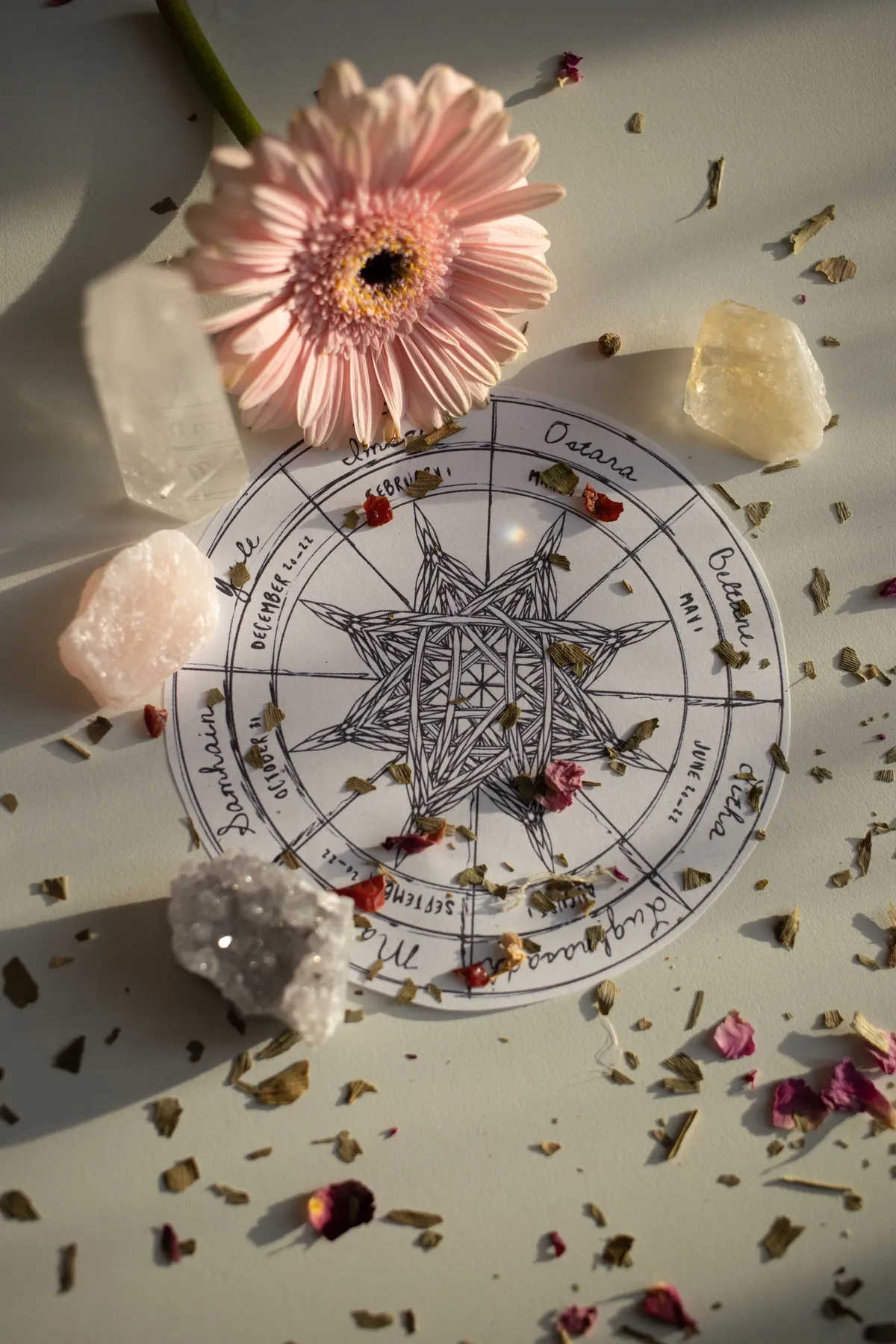
The Wheel of the Year: Every Sabbat, Explained
(From a Goblin Who Has Now Written About Every Single Season)
Bramble here. I have now, somehow, written a guide to every single sabbat on the Wiccan calendar — all eight of them, start to finish. This is more sustained commitment than I’ve shown to most things in my life. Eight festivals mark the turning of the year — four fire festivals sitting between the solstices and equinoxes, and four solar points marking the equinoxes and solstices themselves. Together they’re called the Wheel of the Year, and it genuinely does keep turning whether you’re paying attention or not.
Here’s the full wheel, in order, with a link through to the complete guide for each one.
“The wheel keeps turning whether you’re paying attention or not. I know this because I have, personally, not been paying attention and it kept turning anyway.” — Bramble
The Eight Sabbats
The first quiet stirring of the year, tied to Brigid and the earliest proof that the light is returning.
Read the Imbolc guide → 20th–22nd MarchThe Spring Equinox — balance tipping toward light, and the Wheel’s most openly hopeful, growth-focused point.
Read the Ostara guide → 1st MayA fire festival of fertility, vitality, and unrestrained celebration, sitting directly opposite Samhain on the wheel.
Read the Beltane guide → 20th–22nd JuneThe Summer Solstice — the year’s longest day, and the sun at the absolute peak of its power.
Read the Litha guide → 1st AugustThe first harvest sabbat — cautious optimism, the earliest cut of grain, and the first proof a year’s work might pay off.
Read the Lammas guide → 20th–22nd SeptemberThe Autumn Equinox — the main harvest, genuine gratitude, and balance tipping toward the dark half of the year.
Read the Mabon guide → 31st OctoberThe final harvest, the Pagan New Year, and the night the veil between worlds is said to grow thin.
Read the Samhain guide → 20th–22nd DecemberThe Winter Solstice — the longest night of the year, and the point the sun is symbolically reborn.
Read the Yule guide →Fire Festivals vs Solar Points
If you’re new to the Wheel, it’s worth knowing it’s really built from two different sets of four sabbats, woven together. The four solar points — Ostara, Litha, Mabon, and Yule — fall precisely on the equinoxes and solstices, marked by actual astronomical events. The four fire festivals — Imbolc, Beltane, Lammas, and Samhain — are the older Gaelic cross-quarter days, falling roughly halfway between the solar points, and historically marked with bonfires and community gathering.
Together, all eight sit at roughly even six-week intervals, forming a continuous cycle rather than eight isolated dates — each one flows logically into the next, from Imbolc’s first stirring through to Yule’s quiet turning point and back around again.
“Eight sabbats, six weeks apart, forming one continuous cycle. It’s basically the only thing in my life that runs on schedule.” — Bramble
Bramble’s Final Verdict
Whatever your relationship to Wiccan practice — devoted, curious, or just someone who likes lighting a candle with intention now and then — the Wheel gives you eight genuine excuses a year to pause and actually notice the season changing. That’s more reflection than most calendars manage. All eight guides are here now, and the wheel, as ever, keeps turning.
— Bramble